

Controlling chemistry with light
Enabling cartilage regeneration using a scaffold made of bio-ink—this is the stated aim of the TriggerINK project. A key component of the ambitious endeavour are molecular light switches being developed by Stefan Hecht and his research group. The team have recently made significant advances in their work—and the potential applications extend far beyond the field of regenerative medicine.
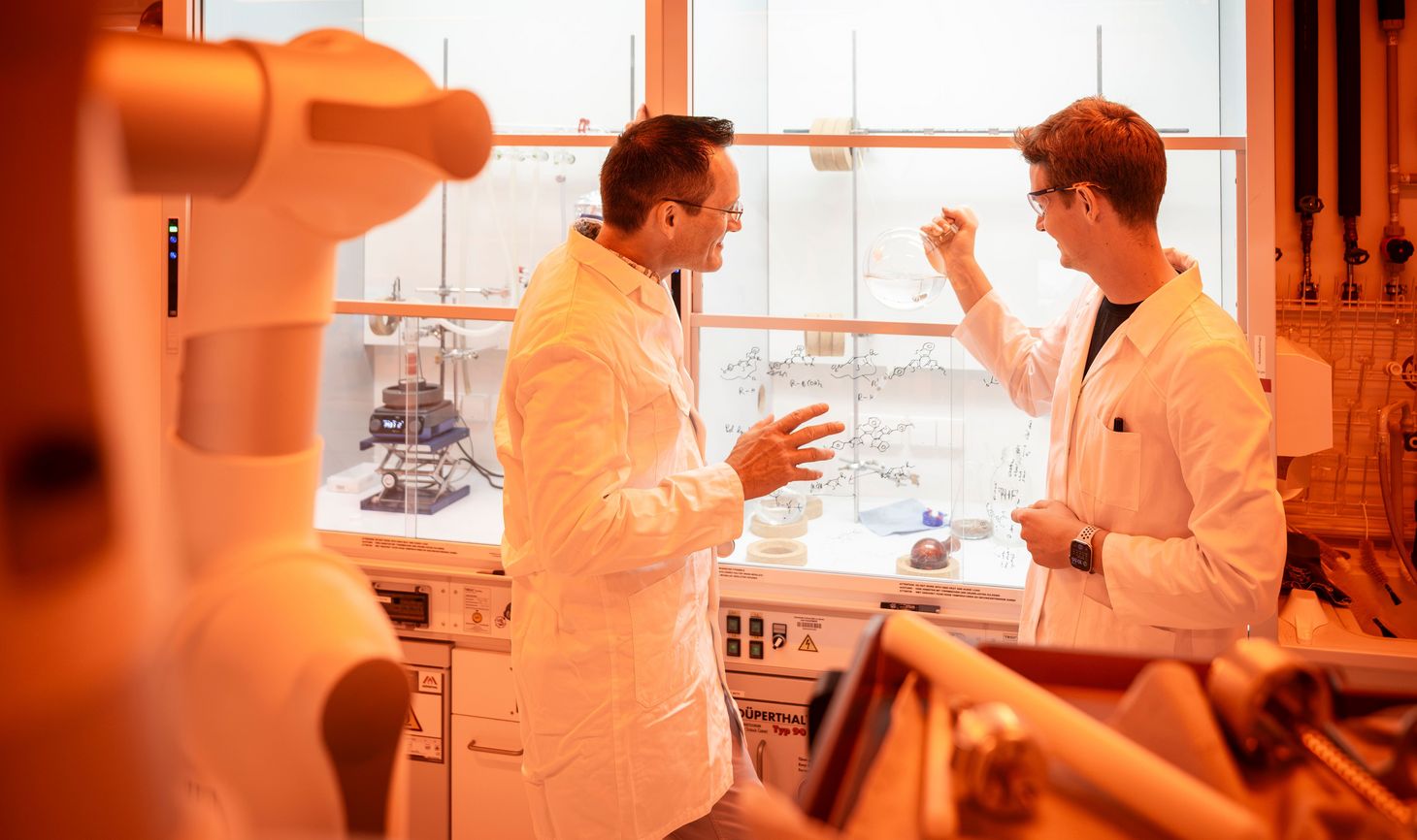
Stefan Hecht’s enthusiasm is contagious when he talks about light. “You can do amazing things with light,” says the chemist and Einstein Professor at Humboldt-Universität zu Berlin. Hecht has spent many years studying how to precisely control chemical processes using light, and his research centres around a technology that holds enormous potential for medicine and materials science: molecular light switches, so called photoswitches.
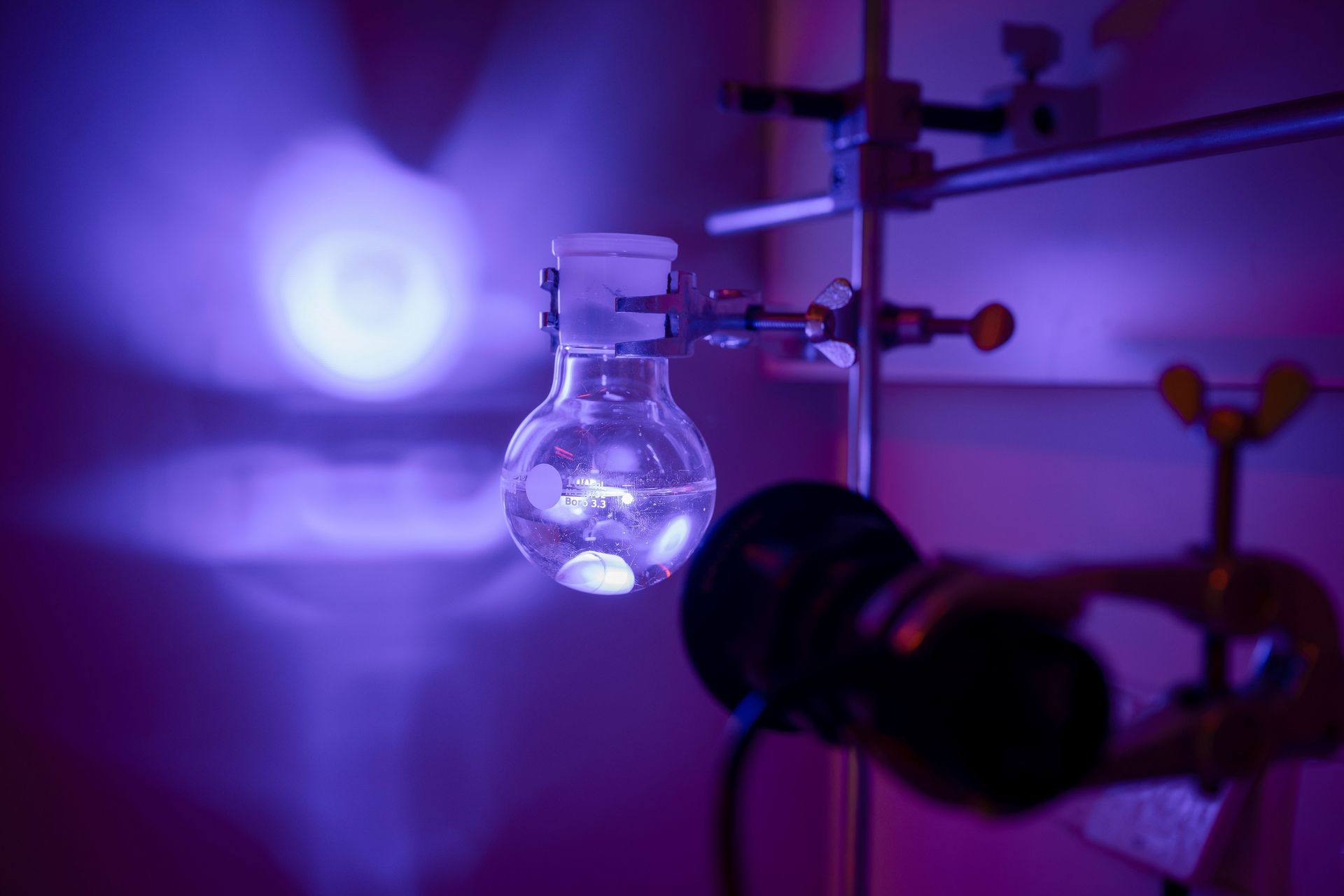
Photoswitches are chemical compounds that reversibly alter their structure when irradiated with light. One light pulse suffices to turn a function on or off. “I like to compare it to Dr Jekyll and Mr Hyde,” says Hecht, “because a photoswitch molecule has two completely different personalities: one is in a state of inactivity—and the other is active.”
Photoswitches enable scientists to control properties remotely and precisely using light pulses, similar to using reagents such as acids or catalysts to activate chemical reactions. This makes it possible to trigger various processes at a defined location and point in time—and also stop them again at will. These capabilities are what make photoswitch technology an important component of the TriggerINK project, which has received funding from the Werner Siemens Foundation since 2022.
Regenerating cartilage with bio-ink
The TriggerINK project’s overall aim is using a novel bio-ink to enable the regeneration of damaged joint cartilage. The idea is to inject the bio-ink—a hydrogel—directly into damaged cartilage, where it will generate a three-dimensional scaffold along which new cartilage tissue can grow. The bio-ink scaffold contains pores and structures that provide orientation for the cells and promote tissue regeneration. Controlling the growth of the scaffold is where the photoswitch comes into play. Hecht says the hydrogel should build up only in those areas that are irradiated with light, which will induce the formation of a stable scaffold at the right time and place.
The chemistry involved in creating a photoswitch is, however, extremely complex. To begin, Hecht’s research team developed a system that could be controlled with ultraviolet (UV) light. “UV triggers reactions far more easily due to its extremely high energy,” Hecht explains, “but that also means it can damage tissue easily.” In seeking a solution to this problem, his team experimented with ways to operate the photoswitch using visible—or even infrared—light, both of which have less energy and are thus safe for use in the body.
Exploiting near-infrared light
The researchers’ efforts have now yielded first promising results. Recently, Hecht’s team have developed no less than three different approaches that open up new possibilities for using these molecular light switches. Because the approach best suited for TriggerINK has not yet been published, Hecht is unable to discuss it in detail. He can, however, reveal the following: “It’s related to the idea that we need sulphur compounds—thiols—to crosslink the hydrogels.” One of Hecht’s doctoral students, Henri Tertilt, has developed a variation in which one form of a molecule reacts with thiols, while another form does not.
“Switching between these forms can be controlled with near-infrared light,” Hecht says. In addition to its safety for use in biological tissue, near-infrared light has the advantage that it can penetrate the body more deeply than visible light. “It can even travel through the skull and into the brain,” he explains, adding that, in principle, near-infrared light could also be used to release signalling substances in the body—to release a specific active substance in a particular region of the brain, for example.
A pause button for chemistry
An article on the second approach was recently published in the Journal of the American Chemical Society (JACS)(1). In this study, another doctoral student in Hecht’s group, Alwin Drichel, used a special dye molecule that changes its structure under blue light. In one form, the molecule is chemically active and takes part in a bond exchange; in its other form, the molecule is practically inactive. Put briefly: light acts as a pause button for chemistry.
The type of bond the researchers investigated in their study is part of dynamic covalent chemistry, which revolves around bonds that are able to repeatedly break and reform. Dynamic covalent systems are promising for smart materials and self-healing plastics. As long as the bonds remain dynamic, a material will continue to change and adapt to its surroundings.
This dynamic exchange process can be controlled with the light-driven mechanism developed by Drichel and Hecht. Irradiating such a molecular system with blue light results in a less chemically reactive form, essentially “freezing” the dynamic system. Removing the light source, then, causes the molecule to slowly return to its active form, and the chemical exchange is once again set in motion.
Increasing and releasing strain
The third approach was recently unveiled in an article published in Chem, with yet another of Hecht's doctoral students, Tom Bösking, acting as the study’s lead author (2). This method focuses on controlling mechanical strain in molecules, as strain can accelerate chemical reactions—indeed, when molecules are forced into an energetically unfavourable, “strained” shape, they often react much faster. Carolyn Bertozzi, a Nobel laureate from the US, applied this principle in her work on strain-promoted click chemistry.
Strain-promoted click chemistry involves integrating chemical groups into strained ring systems. The stored strain essentially becomes the driver for a reaction. This technique has found widespread application in biological research today, as it makes it possible to link molecular building blocks together quickly and precisely without having to rely on catalyst materials such as copper, which are toxic for living cells and organisms.
“But we also want to determine when and where these reactions take place,” says Hecht. And this is exactly what his team achieved, arriving at a solution reminiscent of a hose clamp. In this system, a photoswitch is used to partition a large molecular ring into two smaller rings, thereby increasing the strain within the structure. Turning off the photoswitch releases the strain in the system.
Opening and closing the molecular ring system makes it possible to selectively change its reactivity, and the researchers demonstrated that they were indeed able to control chemical reactions using their “clamp”. In this approach, light serves not only as a switch but also as a tool that releases the mechanical energy stored within a molecule.
Modifying plastics with light
All three of these approaches revolve around the same fundamental question: How can a chemical reaction be triggered only where it’s needed? While this same question is at the heart of the TriggerINK project, Hecht also envisions applications of the photoswitch that extend far beyond cartilage regeneration. Indeed, he believes the approach published in JACS could one day be used in the polymer technology field—in the manufacture of modifiable plastics, for example.
The latter application is interesting because plastics are nothing other than long chains of individual building blocks (called monomers) that are chemically attached to each other. Crosslinking them with a photoswitch could make it easier to break down and modify such materials. Extensive crosslinking makes polymers (chains of monomers) stiffer, which is ideal for robust products such as sturdy plastic components, while breaking the crosslinks makes a material more pliable, allowing it to be processed into plastic films. “That would be especially attractive because it’s practically impossible to chemically break down many of our current plastics, and the recycling rate is low,” says Hecht.
Fishing with light
Hecht sees another application for the ring system photoswitch—namely, that it could one day enable scientists to observe processes taking place within living cells. The idea is to place a photoswitch molecule in a cell, where it’s activated at a precisely defined location and point in time. A highly reactive chemical group is then released that acts as a type of molecular trap, capturing directly adjacent proteins or other types of molecules. Hecht calls the process “going fishing with light”.
“Even today, we still know very little about how processes inside cells take place,” says Hecht. “With this method, we could see which molecules are present near which organelles at a specific point in time. Or the pharmaceutical industry could find out which molecules their active substances form bonds with.”
Much basic research is still needed before such scenarios become reality. Yet even so, they illustrate that the significance of photoswitch chemistry extends far beyond its use in the TriggerINK project. Indeed, photoswitches could one day open up entirely new possibilities for gaining spatial and temporal control of chemical processes.
Text: Simon Koechlin
Translation: Mary Carozza
Publications