


Materials for building the future
Without the development of new materials, modern technologies such as smartphones and aeroplanes wouldn’t exist. And researchers are continually expanding the repertoire of available materials, as demonstrated by three WSS projects—“Climate-friendly, durable reinforced concrete”, “Artificial muscles” and “Thermoelectric materials”—all of which explore very different approaches for very different applications.
Material developments drive societal developments. In the Stone Age, for instance, early humans used stones, bones and fibres to make tools and weapons. Later, in the Bronze Age, our ancestors discovered that an alloy of copper and tin produces a material that’s harder and more durable than stone. This discovery enabled them to produce better tools and weapons—as well as artwork—and it led to the establishment of artisanal crafts and trading networks.
Exactly how these new materials and manufacturing processes originated is impossible to reconstruct today. Especially as history shows that even major researchers and innovators can be forgotten. Who, for example, remembers Leo Baekeland, the Belgian-American chemist and, in 1907, inventor of the first synthetic plastic—Bakelite.
It is, however, safe to say that without the development and refinement of materials and material properties, our modern world would simply not exist. There would be no bridges, no smartphones, electric vehicles, aeroplanes or solar cells. Of course, the work is not close to being finished: researchers continue to create and further develop innovative products made of novel materials. The research field is broad, ranging from investigations into entirely new properties—quantum materials, for example—to the refinement or modification of existing materials.
Strong, proven—yet largely unknown
An example of the latter is the “Climate-friendly, durable reinforced concrete” project led by Ueli Angst at the ETH Zurich Department of Civil, Environmental and Geomatic Engineering. More than two thousand years ago, ancient Romans were already using concrete made from natural materials to build aqueducts and structures such as the Pantheon. In the mid-19th century, engineers had the clever idea of reinforcing brittle concrete with a flexible material: steel.
“This development of reinforced concrete is ultimately what enabled industrialisation,” Ueli Angst explains. “Steel and concrete represent a super-symbiosis: they’re available in large quantities worldwide, and they’re exceptionally robust.” The combination of steel and concrete led to the construction of incredibly sturdy, durable and load-bearing structures, including architecturally complex designs such as bridges with large spans. The new method proved highly successful—at least until the ravages of time began to take hold. Corrosion in particular can shorten the service life of steel and nega-tively impact a structure’s safety—and have potentially catastrophic results. “Seen in this light, it’s surprising that we still don’t understand corrosion processes in reinforced concrete fundamentally,” Angst says.
Compiling this body of knowledge is the aim of his project—and not only because corrosion is costly. Angst also points out that the knowledge gaps surrounding corrosion in reinforced concrete have another grave consequence: they’re what prevent new, more environmentally friendly concrete materials from being used in the building industry. “The industry is in urgent need of a fundamental rethink,” Ueli Angst says with conviction.
Examining the steel-concrete interface
The challenge lies in the seemingly intractable link between corrosion protection and the large amounts of CO2 emitted when concrete is manufactured. Concrete contains a high proportion of the binding agent cement, and traditional cement production methods using limestone and clay minerals not only consume a great deal of energy for heating the furnace—they also centre around calcination, a chemical reaction that releases large quantities of CO2. Mixing the cement with water then produces an alkaline solution that slows disintegration of the steel. “According to current doctrine, only high-alkaline reinforced concrete is protected against corrosion,” Ueli Angst says. “In modern, environmentally friendly concrete, this alkaline shield is weakened, which—according to conventional wisdom—represents a durability problem.”
However, Angst’s research has already demonstrated that the doctrine is valid only to a certain extent, and that it’s also possible to prevent corrosion of steel rods embedded in concrete by controlling other factors, including the flow of water through the concrete’s pore system as well as the chemical composition of the pore solution. Nevertheless, many of these processes must first be studied in detail. Only after this knowledge has been compiled will it be possible to develop new strategies and materials that will enable broader use of climate-friendly concrete in the construction industry.
The exact formulation of these sustainable strategies depends on a variety of factors. In some cases, it will be possible to use low-alkaline cements that are nonetheless corrosion-resistant. In other cases, it may be necessary to use additional methods such as coatings to protect concrete and steel from moisture—or add novel ingredients to equalise the concrete’s humidity levels.
Atom by atom
The complex interactions occurring at the interface between concrete and steel play a key role in Ueli Angst’s project. The pore sizes in concrete range from nanometres to centimetres, and they can change over time. Depending on the conditions—in dry weather, for example, or when a concrete support is submerged in water—different chemical reactions take place between the steel and concrete. Should water penetrate the concrete pores, dissolved gases such as CO2 react with other components of the concrete. These reactions are in turn linked to electrochemical processes on the steel’s surface.
Ueli Angst has now hired four PhD students for the project, which started at the beginning of 2025. One of them is investigating the critical interface between steel and porous concrete, and that literally with atomic precision. Using a tomographic atom probe, atoms are removed from the surface of a sample and then analysed to determine their mass. “The findings here will allow us to reconstruct this crucial area, atom by atom,” Angst says.
Another PhD student is studying how pores in cementitious matrix behave when water is washed in. Main questions here concern whether the pores seal up or get larger. A further line of inquiry is exploring the role of CO2 that has been dissolved in water. In particular, the researchers want to know whether it can, under certain conditions, act as a catalyst that accelerates the degradation of iron in the steel. All these research strands serve a single purpose: gaining a thorough understanding of corrosion processes in reinforced concrete.
Stretchy energy converters
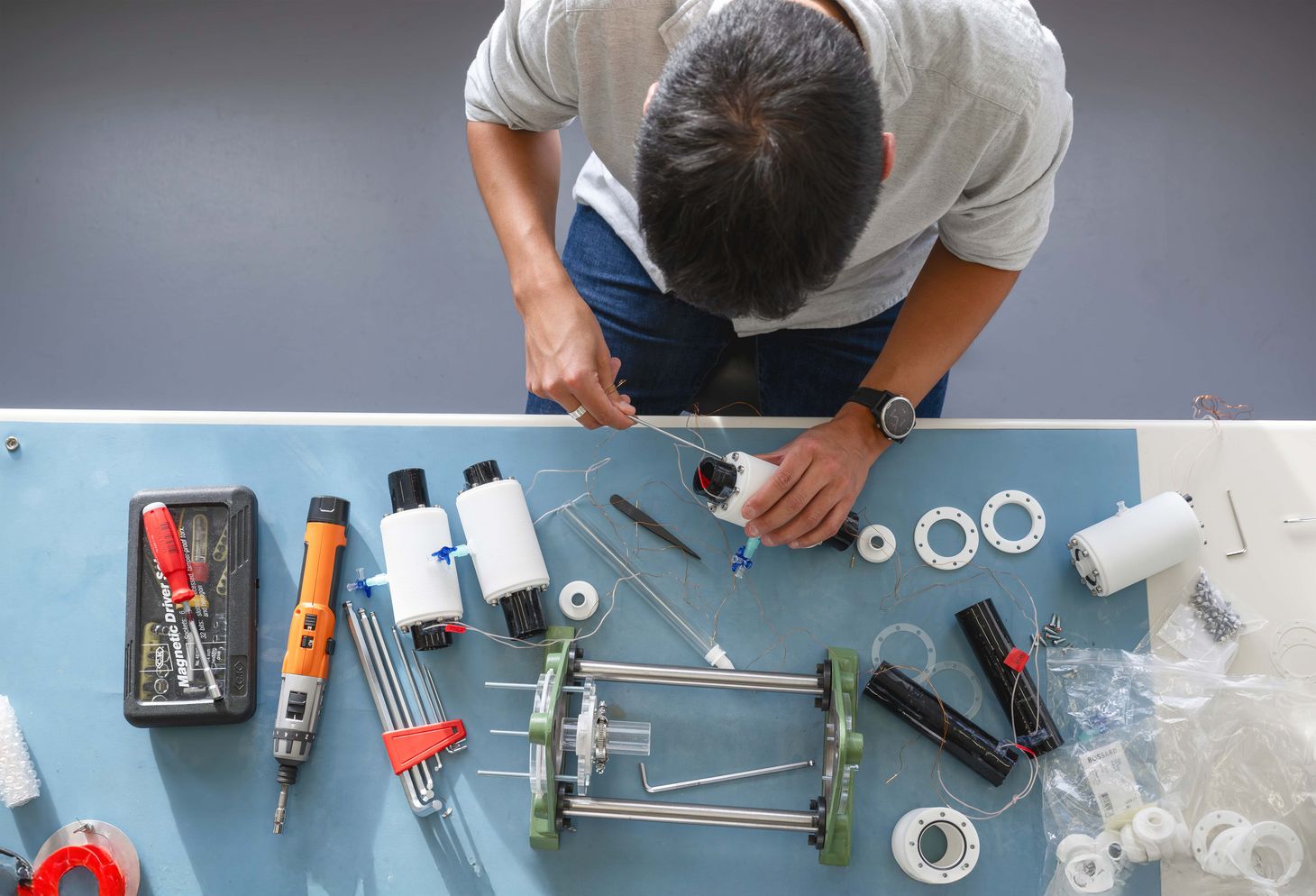
An entirely different type of material is being studied in the team led by Yves Perriard and Yoan Civet at the Centre for Artificial Muscles on the Neuchâtel campus of the École polytechnique fédérale de Lausanne (EPFL). Compared to steel and concrete, this material is still in its infancy—dielectric elastomer actuators (DEAs) have only been developed and studied since the 1990s. These actuators consist of a thin, highly elastic plastic film that’s stretched between two electrodes. When a voltage is applied, the plastic lengthens, converting electric energy directly into mechanical work.
The elastomer film can be made of various kinds of materials, with silicone, acrylic and rubber being the most common choices. “The perfect material for dielectric elastomer actuators is pretty much the holy grail in our research community,” Yoan Civet says. The most important elastomer features include the ability to stretch, maximise energy storage and withstand a strong electric field.
The EPFL researchers are using these kinds of flexible materials to develop artificial muscles that could be used to treat heart conditions or facial paralysis. “A few years ago, we worked with researchers from a French university to seek the perfect DEA material ourselves,” Civet relates. “We found three very good materials. Unfortunately, however, all three were liquids, which made them impractical for our purposes, as their liquid form significantly complicated the actuator fabrication process. And so we opted for a commercially available film.”
Major boost to performance
Now, however, the search for materials has once again become a major focus, as Perriard explains. This is because the researchers and engineers have made excellent progress in other areas of the flagship project—developing an artificial muscle to support the heart’s pumping capacity. In a recent publication, the team presented their “artificial heart” consisting of a multi-layered DEA tube inside a cylindrical plastic vacuum chamber. When a voltage is applied, the internal pressure of the vacuum chamber causes the DEA to inflate, thereby creating a suction action that draws blood into the device. As soon as the electric field is deactivated, the actuator contracts and pushes the blood out again.
The device weighs less than two hundred grams, consumes very little energy and is extremely powerful. “This is the first DEA-based pump that matches the blood flow rate and pressure of the heart muscle,” Yves Perriard says. “This means we’re not just able to support the heart, as with earlier models. We can actually replace it.” The device has the potential to help patients suffering from cardiac insufficiency, whose hearts are no longer strong enough to pump blood through the body.
“Our development is now becoming really interesting for the surgeons we work with,” Perriard says. Indeed, compared to conventional ventricular assist devices, the Neuchâtel system has clear advantages, mainly because the soft materials protect the blood flowing through them. The researchers are now focusing their energies on preparing the next series of animal experiments. “We’re planning long-term tests with sheep. We want to monitor how well the animals tolerate our implanted heart pump for at least thirty days,” Perriard explains.
Wanted: better materials
For the animal tests, the researchers need a highly reliable system that will continue to function, even after thousands of charging and discharging processes. Ensuring the system’s safety poses another major challenge, as Perriard relates. Dielectric elastomer actuators typically require a voltage in the kilovolt range to function. “This is less than ideal for a medical technology product, as it raises concerns about patient safety.”
Because material innovations could be a decisive factor in overcoming these obstacles, the team is looking into whether more powerful DEA materials that function at lower voltages are available on the market. Yoan Civet says he knows of firms that can convert high-quality fluid DEA materials into a film.
Meanwhile, a materials science and manufacturing techniques expert has recently joined the team to investigate whether commercially available dielectric liquids can be enhanced through the addition of other components. “That we’ll develop an entirely new product ourselves, however, is simply not realistic,” Civet says. “We need a material that not only functions well in the lab with small quantities—it should also maintain its function in practical, large-scale and long-term applications.”
Nanocrystals with defects
By contrast, a third WSS project is literally about creating new materials from scratch, as it were. Researchers led by Maria Ibáñez at the “Werner Siemens Thermoelectric Laboratory” at the Institute of Science and Technology Austria (ISTA) in Klosterneuburg near Vienna are using nanoparticles made of highly specific materials to fabricate macroscopic materials with thermoelectric properties. In other words, materials capable of converting temperature differences into electrical voltage—or, conversely, using applied voltage to transfer heat. The thermoelectric effect can be used for generating electricity or for thermal management.
“The core idea of our project is designing and controlling functional inorganic materials,” Ibáñez explains. In simple terms, the trick lies in taking advantage of structural irregularities. “We can adjust features such as defects and interfaces in our materials to optimise the flow of electric charge and thermal energy through a solid,” Ibáñez says. These defects are deviations from the ideal, regular arrangement of atoms in a crystal lattice—for example, when an atom is missing or has been replaced by a different atom, or when a row of atoms has been displaced. And when larger scales are concerned, the boundaries between crystals—grain boundaries—as well as pores play an important role.
Generating the right defects
Such defects can greatly alter a material’s properties. “We can radically change a material’s electrical properties simply by adjusting the type and density of defects,” Maria Ibáñez explains. In such cases, the challenge is to deliberately generate the right defects. “We’re learning how to control defects across different length scales, from atomic vacancies all the way up to grain boundaries. That said, achieving a predictable, scalable degree of control remains difficult.”
The nanoparticles that Ibáñez and her team use as base materials consist of an inorganic core and surface particles such as ions, organic chains or metal complexes. “We’re trying to exploit the properties of the inorganic core—its composition, crystal phase, size and shape—and to adapt the surface chemistry to encourage formation of the desired defects,” Ibáñez explains.
A 3D printer for the record books
One problem facing Ibáñez and her team is that a virtually unlimited variety of nanoparticles with different surface properties could be tested. To solve this dilemma, she’s seeking methods to speed up production and analysis of the samples. An essential part of this effort is the establishment of a high-throughput lab for the automated fabrication and testing of samples. Ibáñez says work on setting up the unique lab is well under way and that it should be completed and ready for use by mid-2026.
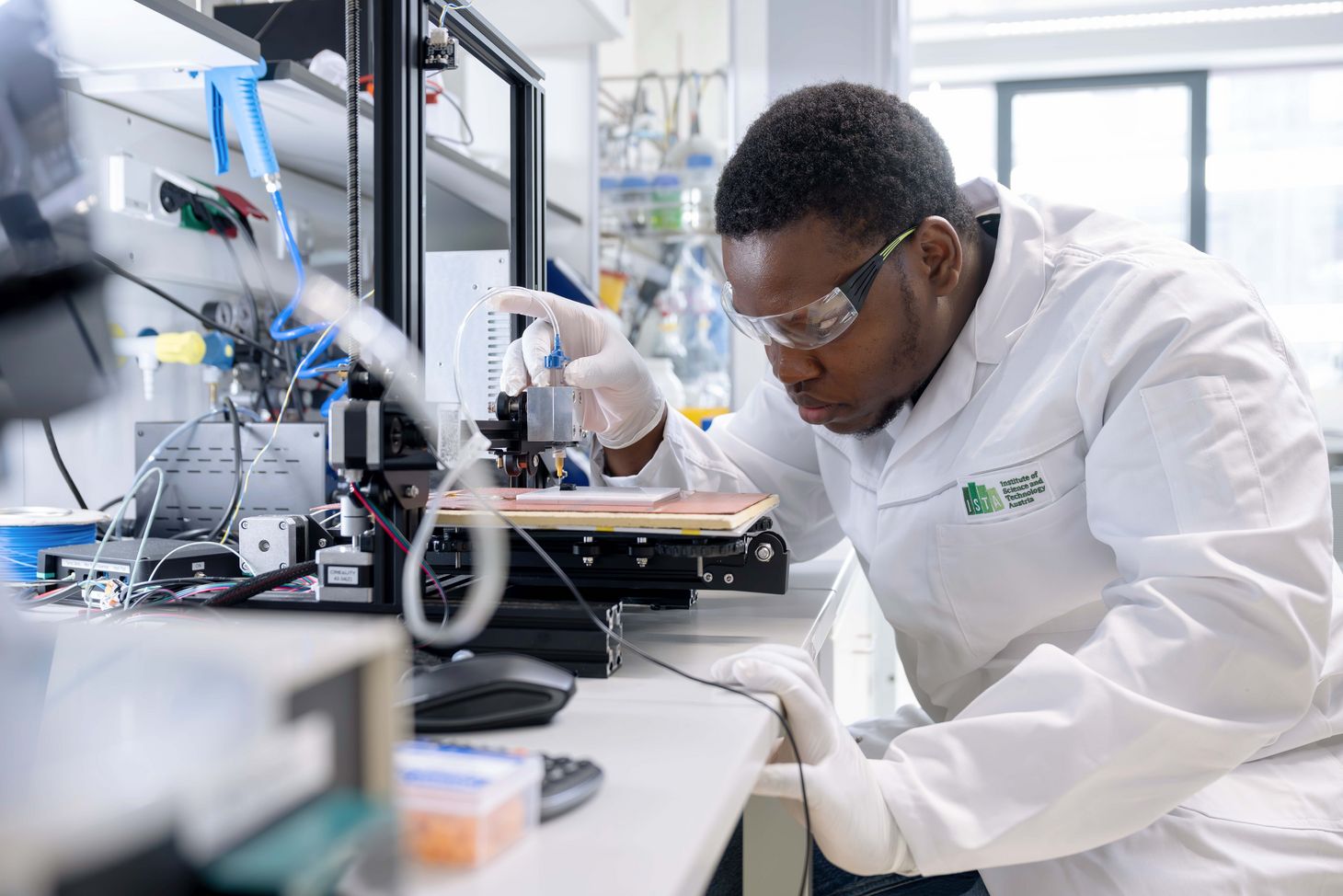
In addition to the high-throughput lab, the researchers are also testing innovative methods such as 3D printing. Last year, Maria Ibáñez and her team published an article in Science describing a new 3D-printing procedure for the cost-effective fabrication of high-performance thermoelectric materials. Ibáñez says previous attempts with 3D printers were unsuccessful, chiefly because the particles in the materials failed to bond effectively and enable good electrical conductivity.
When designing their “printer ink”, the researchers combined thermoelectric powder particles with a carrier solution and binding agents. After printing the ink layer by layer onto a surface they then heated the structure, causing the carrier solution to vaporise. Due to the ink’s chemical properties, the heating phase induces a chemical transformation that fuses the particles together without altering the printed structure. Using this method, the researchers were able to fabricate extremely high-value materials with one of the highest thermoelectric outputs ever observed at room temperature.
Reuse instead of refuse
Sustainability is also a priority for the ISTA team. “Our solvent-based approach enables syntheses at very low temperatures—or even room temperature—that don’t require high-purity substances,” Maria Ibáñez says. The drawback is that the solvents are normally discarded at the end of the process. The researchers are now seeking ways to prevent waste and save materials. In this area, too, they can already report some initial success. “Recently, we proved that silver selenide retains its high performance even after the starting solvent has been reused several times,” Ibáñez says.
The example shows: it’s not enough to develop, refine and seek innovative applications for materials. They must also be handled with care.


![[Translate to English:]](/fileadmin/_processed_/d/f/csm_01_WSS_News_Beton_90d32370a8.jpg "[Translate to English:]")