


Twelve marvellous
matters of fact
The most expensive substance in the world, the oldest glue and the most common mineral: in the following, we present a few superlatives—and some other surprising titbits—on matter and materials.

Extra-terrestrial iron
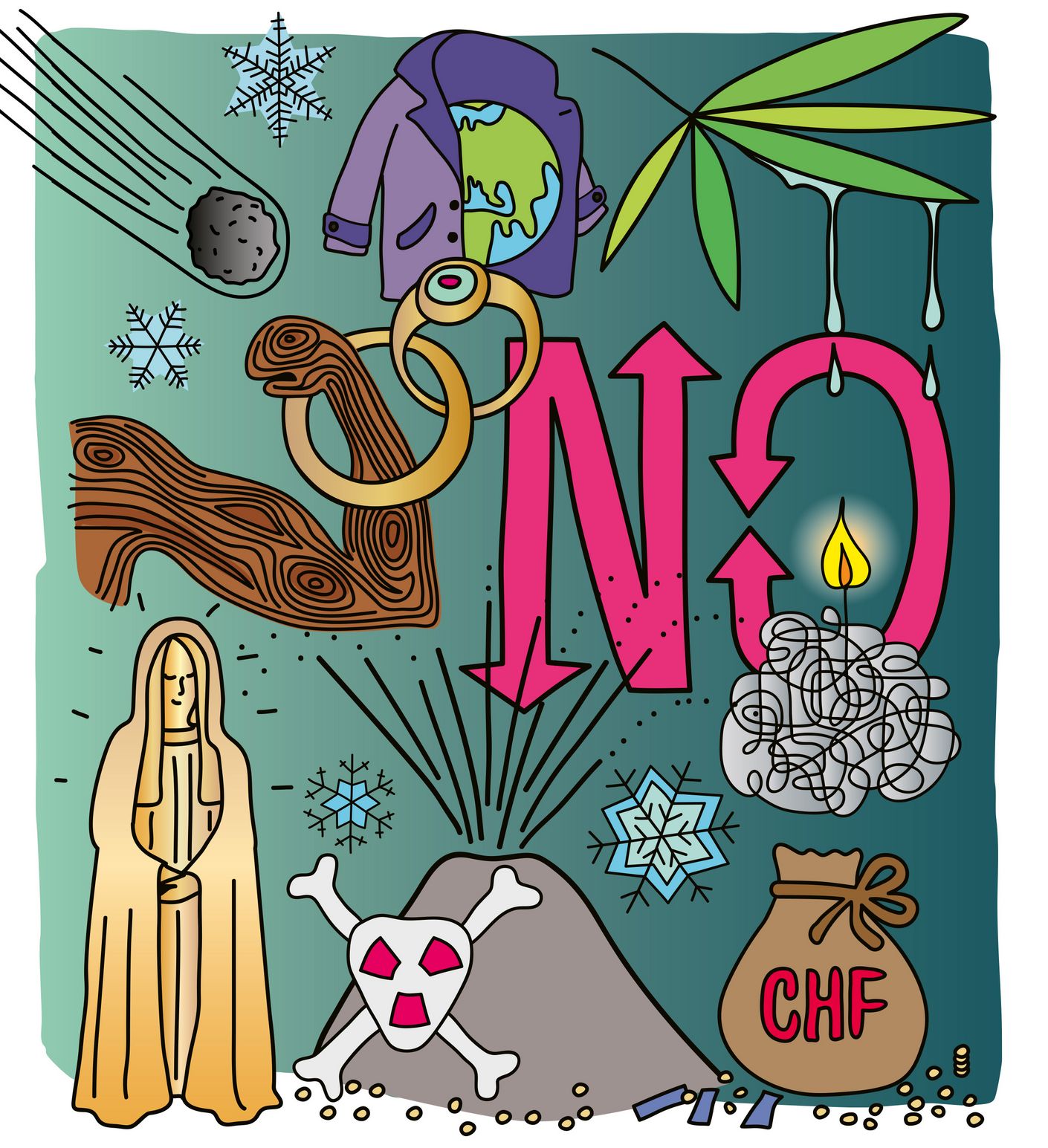
In Pharaoh Tutankhamun’s grave—which dates back some three thousand four hundred years—several iron objects were found, including a finely wrought dagger measuring thirty-five centimetres. The strange thing about the iron is that it’s not from Earth. It came from a meteorite, as the metal’s high nickel content proves.

A ubiquitous stranger
The most common mineral on Earth is bridgmanite. News to you? That’s perhaps not so surprising, given that the substance has only ever been found on the Earth’s surface one single time—in a meteorite. Bridgmanite forms at high temperatures and pressures, like those found in the Earth’s mantle starting at a depth of six hundred and sixty kilometres. There, however, bridgmanite is so profusely abundant that it makes up thirty-eight percent of our planet’s volume.

Incandescent iron
Iron is flammable. It’s just that lighting it in its normal state is difficult, because not enough oxygen can penetrate the dense material. When iron is in the form of wire wool, however, it can be used as a fire starter—depending on the type, wire wool burns long and bright when lit with a match.

Ancient glue
More than one hundred thousand years ago, our ancestors created a sticky concoction for affixing stone blades to their spears by distilling the leaves of a shrub in the Podocarpaceae family. The adhesive has robust mechanical properties and is stronger than naturally occurring substances like resin.

Good wood
A wooden cube with an edge length of four centimetres can withstand four metric tons of pressure. Its fibrous structure is what makes wood so sturdy—especially when a load acts along the grain. And there’s more: because wood is elastic, it changes it shape under pressure rather than breaking immediately.

Odd anniversaries
Everyone knows what a silver (25-year) or golden (50-year) wedding anniversary is. But what about an aluminium anniversary (37.5 years)? Here are a few other unusual designations: a brass anniversary (45 years), uranium anniversary (53 years), platinum anniversary (55 years), mercury anniversary (63 years) and a cast-iron wedding anniversary (73 years).

Shifting snows
The idea that a blanket of snow is stable and unchanging is misleading, as researchers have demonstrated using computed tomography. They discovered that snow is in perpetual motion, and its structure in a state of permanent transformation. With new ice crystals constantly forming and old crystals disappearing, snowflakes are rarely more than three days old.

Mediaeval nanotechnology
Many mediaeval sculptures have a superfine gold coating that—despite being a mere thirty nanometres thick—is applied with an astonishing uniformity. It’s difficult to imagine how artisans managed this using the simple tools of the time. What’s certain, however, is that the ultra-thin layers saved a lot of material. And money.

Deadly radioactivity
Polonium-210 is one of the most radioactive substances known. One milligram emits one hundred and sixty-six gigabecquerel—which means it loses one hundred and sixty-six billion atoms per second. This intense radioactivity makes even tiny amounts of polonium-210 extremely lethal. It was the poison used to kill former Russian intelligence officer Alexander Litvinenko in 2006.

World’s most expensive material
Antimatter is extremely rare in our universe. All the same, scientists at the CERN research centre in Geneva managed to fabricate one billionth of a gram of antimatter—to the tune of a few hundred million Swiss francs. Just one single gram would cost some one hundred quadrillion francs, making antimatter by far the most expensive material ever made.

Unconquerable concrete
Roman concrete structures like the Pantheon in Rome have withstood the ravages of time for two millennia and counting. The secret in the sauce is volcanic ash, which the Romans mixed in their mortar to lend the concrete its unique strength. They also added little lumps of lime to trigger a chemical reaction that actually seals cracks. Remarkably, Roman concrete can heal itself.

Material dead-end
Every year, the average Swiss citizen uses up sixteen metric tons of material, more than forty percent of which are minerals (mainly gravel and sand). Other consumables include ores, fossil fuels and biomass. Recycled materials make up just seven percent of the entire lot—the remaining ninety-three percent is brand new.