

Fishing for new facial muscles
Researchers at the EPFL Center for Artificial Muscles (CAM) have created a robotic fish whose body is made of soft artificial muscles. Rather than being designed for underwater exploration, however, the unusual prototype will serve as a testing platform for artificial facial muscles that could one day enable people with facial paralysis to smile again.
A fish to put a smile on our faces. The statement doesn’t make a great deal of sense, at least not initially. But for the team led by Yves Perriard and Yoan Civet at the Center for Artificial Muscles (CAM) on EPFL’s Neuchâtel campus, it represents a logical step forward. In a recent study (*), the CAM researchers introduced their robotic fish, whose movements are powered by the soft, elastic membranes that have been developed in the artificial muscles project funded by the Werner Siemens Foundation. The project’s overarching aim is to use these membranes to help treat patients with cardiac insufficiency, urinary incontinence or facial paralysis.
“We envisage using the fish as a platform to test new concepts for developing artificial muscles for people with facial paralysis,” says project leader Perriard, who readily admits that the idea sounds a little unconventional. “But the technical challenges are surprisingly similar in both applications.” A central factor is that, like the muscles that propel a fish, our thin facial muscles are attached seamlessly in the limited space beneath our skin. Creating a natural expression would be impossible if the replacement muscles were attached to a separate rigid or semi-rigid structure. At the same time, the membranes must also generate enough power and displacement to cause visible, natural movement in the corners of the mouth.
Muscles form the body
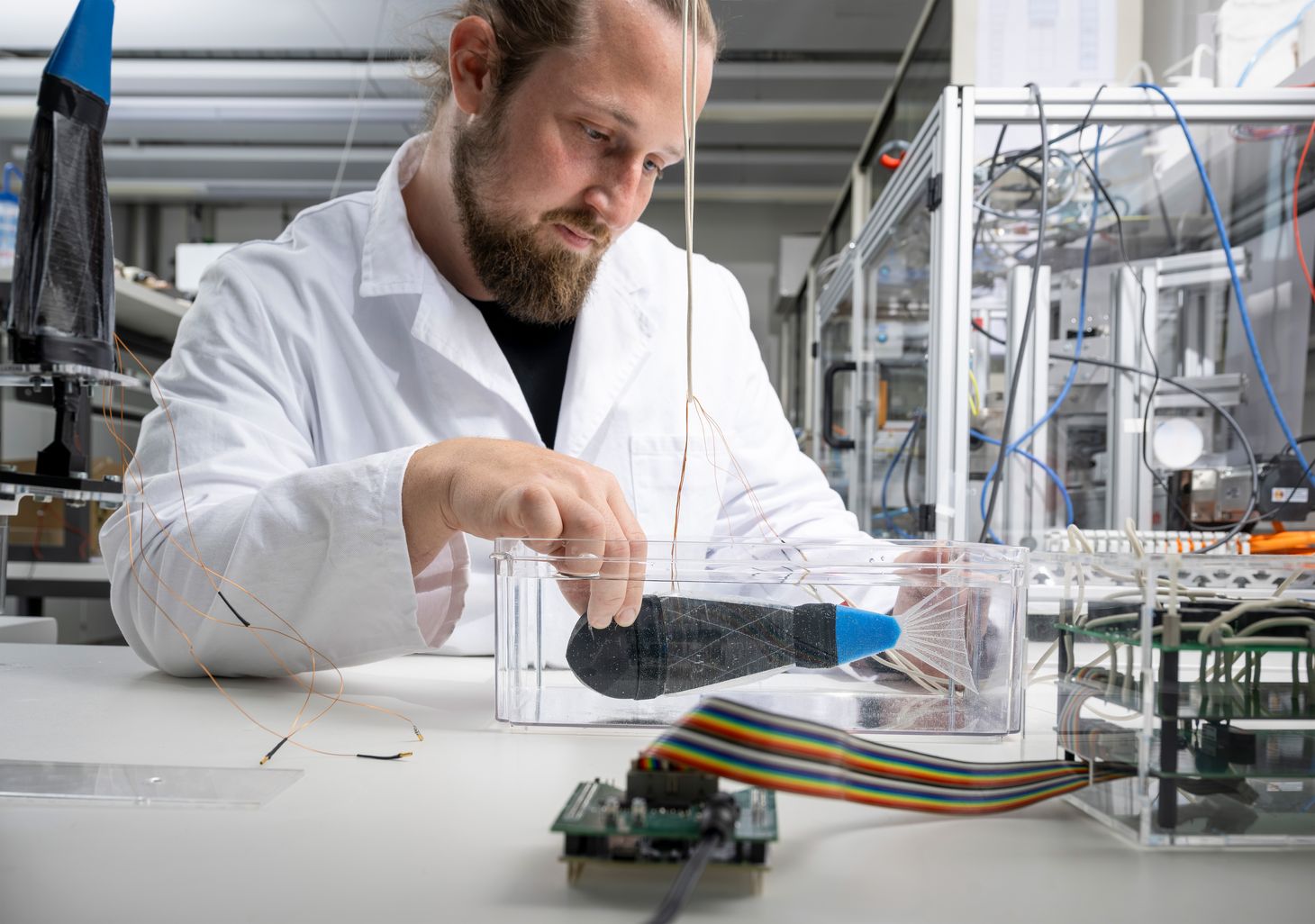
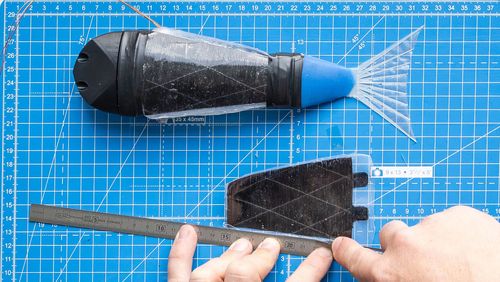
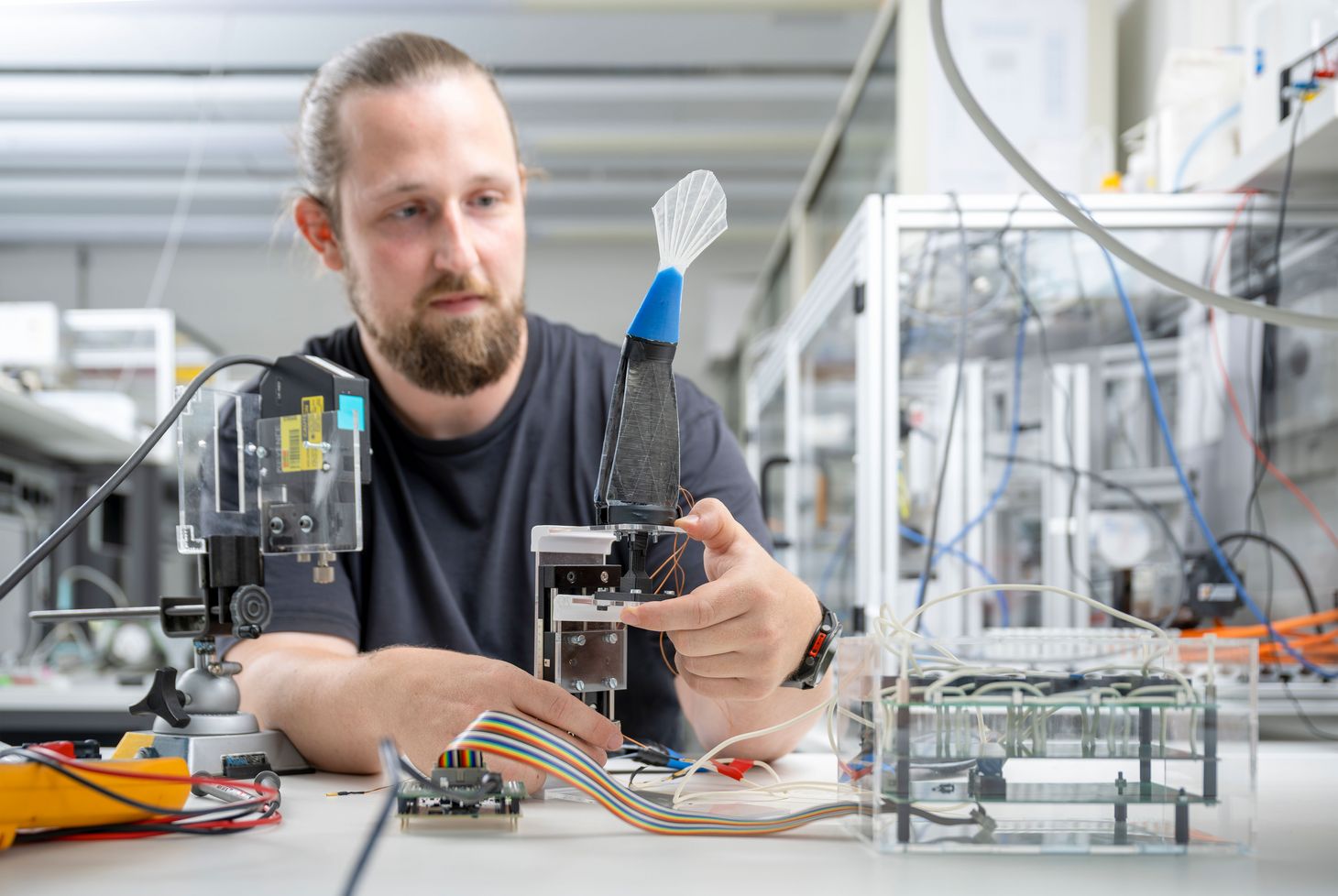
The DEA Fish—the name given to the eighteen-centimetre-long swimming robot—meets the requirements. Unlike many other robots that are made up of motors and joints mounted on a rigid framework, the CAM model unites artificial muscles, outer body and physical shape into a single coherent structure. Both sides of the fish’s body are formed by dielectric elastomer actuators (DEA), the thin silicone layers between electrodes that give the fish its name. When an electric voltage is applied, the electrodes attract each other, causing the silicone layer to grow thinner and elongate. This is how the actuators convert voltage into movement—similar to processes in biological muscles.
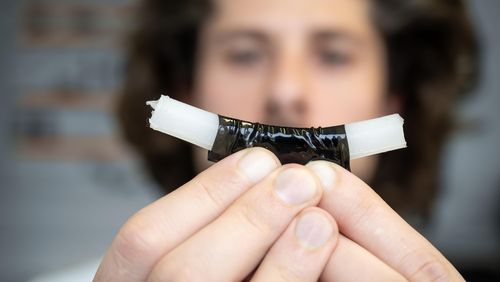
The researchers also reinforced the silicone membranes with stiff fibres in order to prevent the soft material from arbitrarily deforming and spreading out in all directions. The fibres guide the movement in the desired direction, a property known as mechanical anisotropy. As Markus Koenigsdorff, postdoctoral researcher and lead author of the study, says: “The fibre reinforcement improves the performance of the artificial muscles—and it also makes it possible to create three-dimensional forms.”
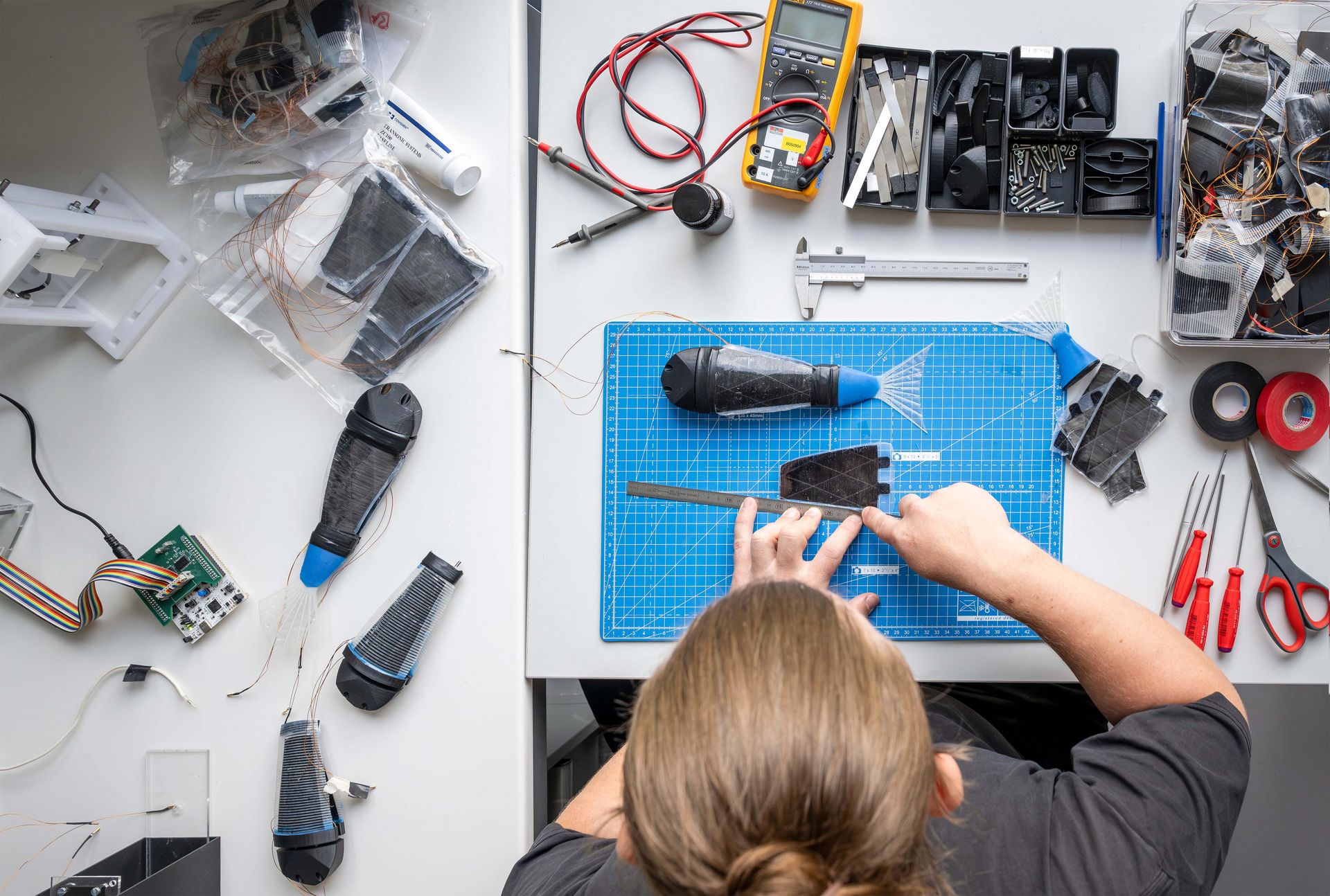
The researchers fabricated trapezoidal elements that taper down from the head of the DEA Fish to its tail fins. They then glued the actuators on flexible surfaces and stretched these surfaces into a curved form between the head and tail to form the outer sides of a hollow, fishlike body. The inside of the robot fish offers enough room to later house the power supply and electronic control system.
Swimming experiment
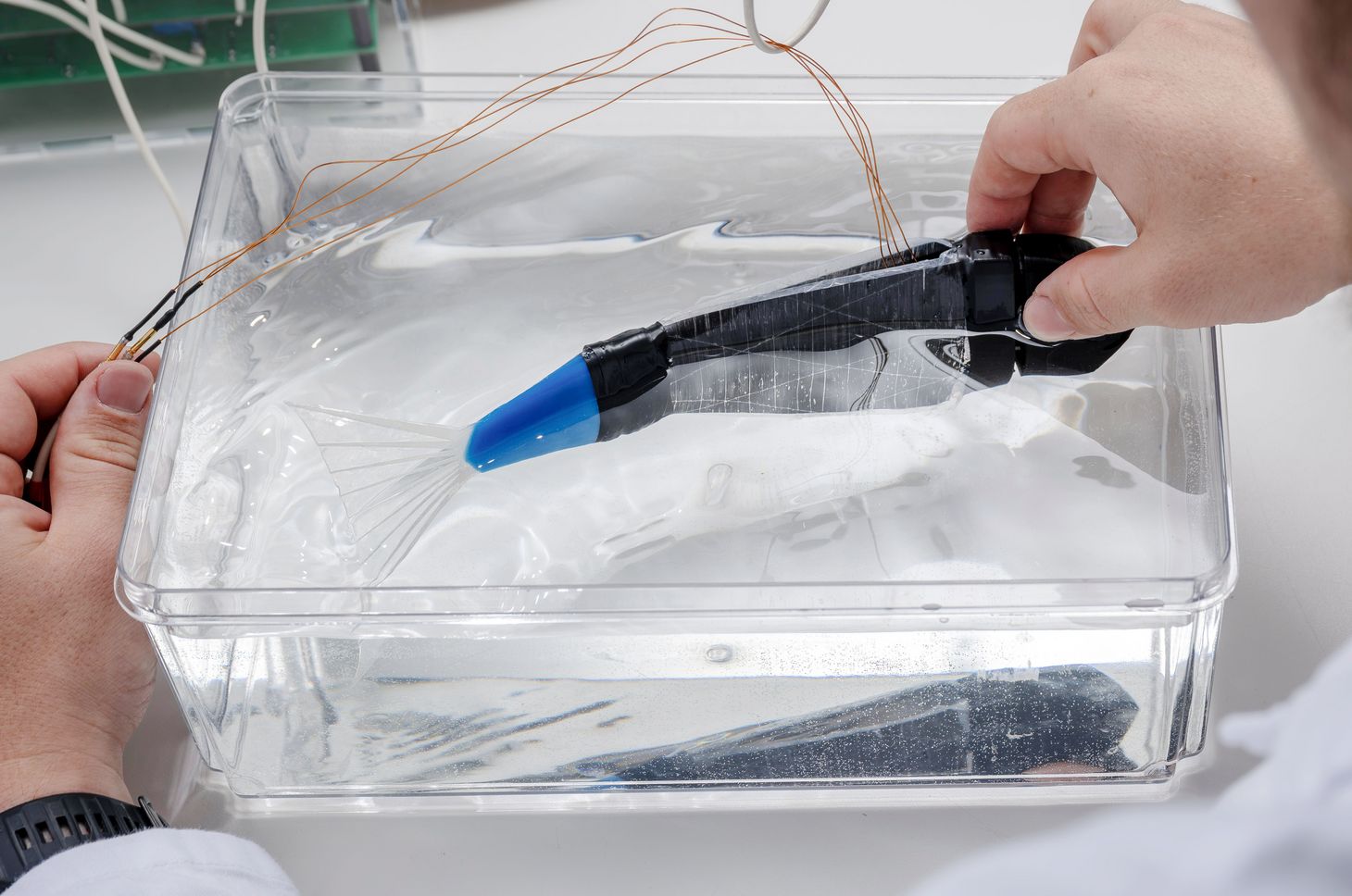
In addition, a thin, spring steel strip runs between the actuators on the sides. The strip functions as the fish’s spine and is flexible enough to bend left and right. The artificial muscles are glued to the curved carrier structure, then prestretched against the central metal spine. When the actuator on one side is switched on and begins to move, the balance shifts: once a certain angle of displacement has been reached, the spine quickly moves in the opposite direction. When the muscle on the other side is activated, the spine snaps back. Koenigsdorff explains that the set-up enables the fish to make large lateral motions with its tail fin.
As part of the study, spring steel strips of various thicknesses were tested. The optimal compromise between strength and flexibility proved to be 0.3 millimetres; thinner strips were too weak to withstand the pre-tension, whereas thicker “backbones” were too stiff and prevented the artificial muscles from functioning adequately. The tail fin’s maximum lateral movement was approximately 5.5 centimetres, and the top swimming speed attained by the DEA Fish in a water tank was six centimetres per second, which corresponds roughly to a third of its length. In comparison with other DEA swim robots, the result is only average, Koenigsdorff says. However, he adds, the CAM model isn’t designed with speed in mind.
Observing aquatic animals
The DEA Fish is not yet an autonomous underwater robot, as it’s powered and steered via cables. To keep the prototype at the desired depth in the fish tank, it was attached to a flotation device on the water’s surface and guided by a wire that spanned the tank. Although the system must still be refined, the experiments nevertheless demonstrated that the novel physical and propulsion concept functions in water, meaning that fin-propelled DEA-based systems could one day be used for aquatic studies.
These types of robots have the advantage that they move silently and are more robust than conventional propeller-driven models. “They could navigate through dense aquatic growth without getting tangled up,” Koenigsdorff says. “Or marine scientists could observe aquatic animals in their natural habitat without acoustic disturbances.” In addition, these types of platforms allow scientists to study the biomechanics of fish—which in turn could result in optimised fin shapes for technical applications.
Precise muscle movements
The CAM research team, however, is less interested in such developments. Rather, their focus is on findings related to the fabrication, insulation and integration of actuators, as well as on voltage supply—aspects that are useful for their research into facial muscles. “The robot helped us to develop a new, reliable electric insulation protocol for our components,” Yoan Civet says. The team also improved fabrication processes and built a test stand for measuring the elastomer actuators’ lifespan in a liquid medium.
The researchers also optimised their facial muscles using a silicone model of a skull. The main challenge here was achieving the greatest mechanical output from the smallest artificial muscles. Another key requirement is improving control mechanisms, as a smile is far from a simple movement in one direction. Indeed, several muscles must function in concert—even minor dysfunctions would lead to an unnatural facial expression.
To enhance precision, the CAM team are also constructing components that have even more complex reinforcement patterns with the aim of enabling artificial muscles to change shape in various directions at different places—and ultimately integrating them more completely into the complex anatomy of the human face. “Natural facial expressions are subtle, coordinated and multidimensional,” Civet says. Creating artificial muscles that demonstrate this flexibility is the greatest challenge in the project.
Text: Simon Koechlin
Translation: Mary Carozza
(*) Study