

Qubits with great chemistry
When different research disciplines join forces, entirely new perspectives can emerge. At the MolQ research centre—which was recently awarded funding from the Werner Siemens Foundation—physicists at the University of Basel and chemists at the University of Bern are co-creating quantum systems on superconductors. Their goal is to develop a reliable, energy-efficient quantum computer.
Who will make the breakthrough discovery leading to the quantum computers of the future? Will it be scientists working in the labs of billion-dollar tech giants like Microsoft, Google and IBM? Perhaps. But it might also be the research teams conducting their studies in the venerable halls of the universities in Bern and Basel. At the new WSS Research Center for Molecular Quantum Systems (MolQ), interdisciplinary research groups are pursuing an innovative strategy to build stable and energy-efficient quantum units, or qubits. Over the next eleven years, the Werner Siemens Foundation (WSS) is supporting the project with a total of fifteen million Swiss francs.
A trip to Bern—specifically, to the labs of privatdozent Shi-Xia Liu at the University of Bern’s Department of Chemistry, Biochemistry and Pharmaceutical Sciences—is a must for anyone wishing to grasp how MolQ’s novel approach works and understand what makes it unique. Students and PhD candidates are busily engaged in experiments using lab flasks, graduated cylinders, pipettes and spectrometers, while chemical reactions take place in fume hoods—box-like work enclosures with glass fronts. At first glance, however, there’s little indication that a quantum computer is in the making, at least not the way the average person might imagine.
And yet it’s here in these rooms that the molecules underpinning MolQ’s innovative quantum approach are being created. Shi-Xia Liu is specialised in converting flat, ring-shaped lattices made of carbon and hydrogen atoms into molecules that possess entirely new properties. For this, she and her team replace the carbon atoms in some of these so-called “aromatic compounds” with nitrogen atoms, before adding halogens such as bromine and chlorine.
One single electron
It sounds simple, says Shi-Xia Liu, and it’s quickly done on paper. “But in the lab, several synthesis steps are often necessary, and the process can take days or even weeks.” These new molecules have an exceptional property: they can acquire single electrons. This is what makes them so interesting for the development of quantum materials. Unpaired electrons have an intrinsic form of angular momentum, called “spin”, and the researchers believe they can use the associated magnetic moment to build qubits.
Qubits are the computing elements in quantum computers—the equivalent of “bits”, which are the basic units of information in conventional computers. But whereas bits have only two states: off (0) or on (1), qubits can have a value anywhere between 0 and 1, theoretically making it possible for them to be in an infinite number of states at the same time. This capability is what allows quantum computers to perform several arithmetic operations simultaneously, rather than in succession.
There is, however, much work to be done before quantum computers will be available for mainstream use. Indeed, although the first machines have been built, they’re currently used only for testing purposes or niche applications. And at present, the competition for making the first commercially viable quantum computer still centres on which qubit-generating technique is most promising. There are various approaches to producing qubits—and hence to storing quantum information—each of which has its advantages and disadvantages (see page XX).
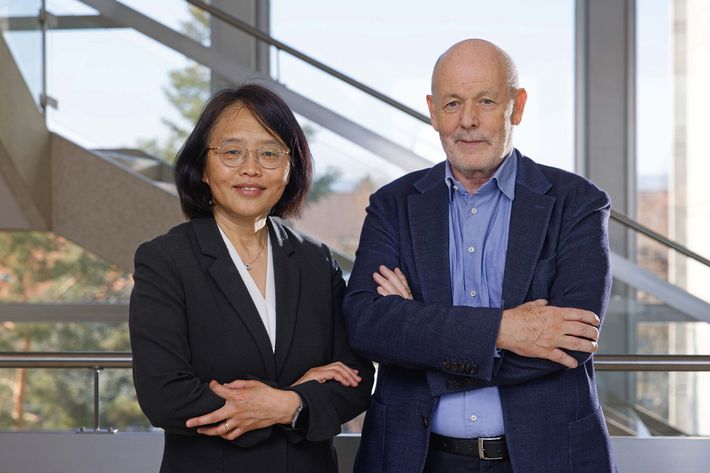
Practically all methods are physics-based approaches that work with individual atoms or light particles, as Silvio Decurtins explains. Decurtins, who is professor emeritus of chemistry, was Shi-Xia Liu’s mentor for many years, and he continues to work closely with her in the MolQ project. He says that theoreticians had already defined the requirements for building qubits thirty years ago, adding: “What we need now are materials that meet the criteria.”
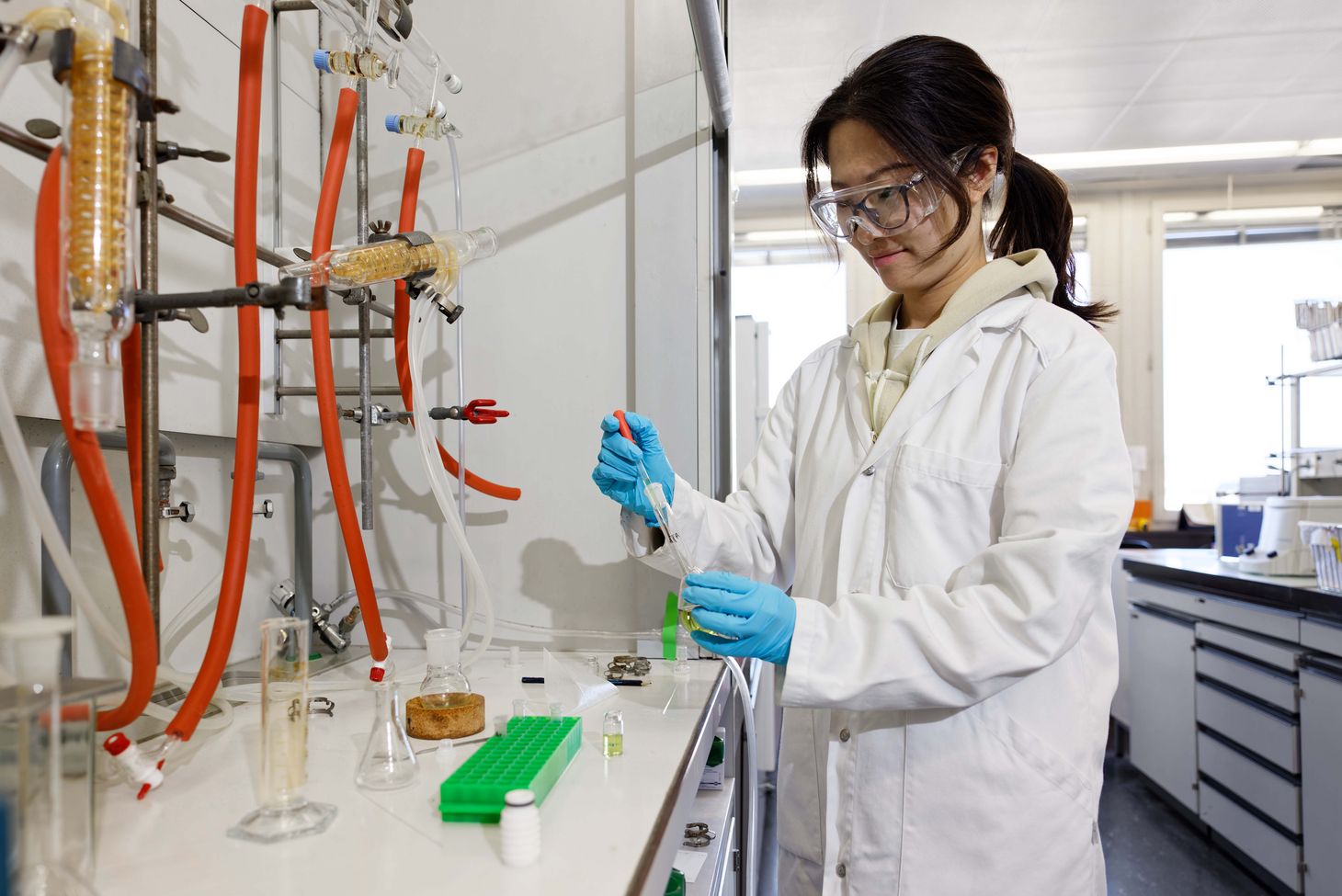
are being fabricated in chemistry labs at the University of Bern.
A game with energy levels
It’s precisely here, in developing these special materials, that chemistry—the science dealing with the structure, properties and transformations of substances—comes into play. “French chemist Marcelin Berthelot once said, ‘La chimie crée son objet’ ”, Decurtins says. In other words, chemists can create their own object of study—and the potential to create materials with new properties in the chemistry lab is nearly limitless.
Despite the fertile possibilities offered by chemistry, however, the properties of the molecules created by Shi-Xia Liu and her research group first become interesting when they come into contact with physics. In the MolQ project, the molecules are deposited on a superconducting substrate, a metal surface on which electricity flows with no resistance. There, each novel molecule acquires an additional electron from the substrate—and with it a magnetic moment. “It’s a game with energy levels,” is how Shi-Xia Liu explains the process. “Only when the free orbital of our molecule is just beneath that of the superconducting substrate will an electron take the leap.”
This fusion of molecule and superconducting material is at the heart of the MolQ project. Due to chemical bonds, the molecules arrange themselves on the superconducting metal surface to form molecular lattices—so-called molecular islands—with precisely controlled size, structure and alignment. In addition, the hybrid material exhibits yet another unusual characteristic: it’s topological. In other words, its particular structure prevents external influences such as disturbances or defects from changing its fundamental properties.
Superconducting edge currents
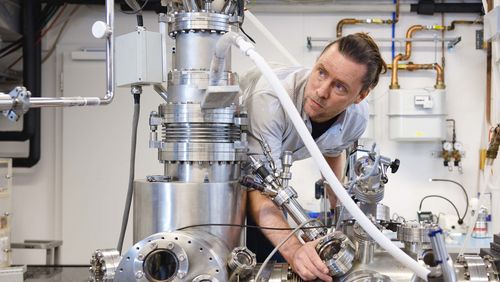
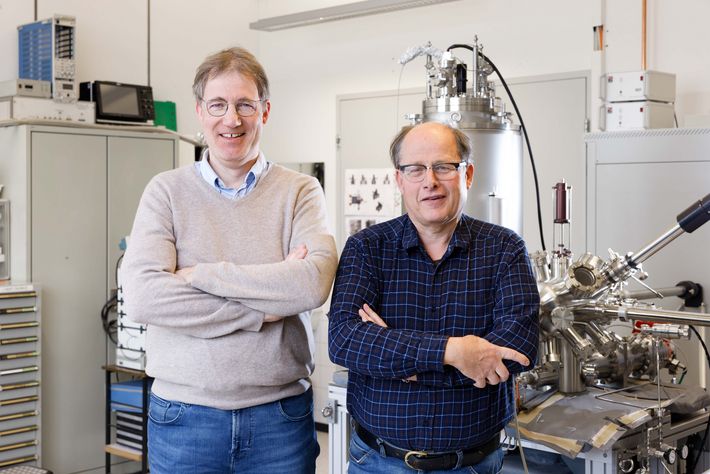
Teams led by Ernst Meyer and Dominik Zumbühl at the University of Basel’s Department of Physics are responsible for constructing the superconducting material and integrating the molecules. Meyer and Zumbühl head the MolQ project, and their laboratories are equipped with several high-performance microscopes and devices enabling them to study novel materials at atomic resolution—and even set off chemical reactions.
Their aim is to arrange the molecular islands on the superconductor in such a way that the charges and magnetic moments generate so-called superconducting edge currents on which electric charges flow loss-free around the molecular islands. This is what enables the system to be used as an information storage device with qubit computing elements. “Coupling topologically protected molecules with superconducting edge currents is the radically new approach that makes the MolQ concept unique,” Ernst Meyer says.
The approach also has several advantages. First, the size of the molecular qubits will be in the nanometre range, meaning there’s room for an enormous quantity of them on a single chip. Second, the superconducting technique ensures low energy consumption. And third, topological protection boosts efficiency. After all, quantum states are extremely volatile and unstable, and most computing errors begin to creep in already after brief computation times. Indeed, the majority of qubits in most techniques are used to detect and correct errors.
Single crystal or vapour deposit
To produce the superconducting surfaces, the researchers are exploring various avenues, as Ernst Meyer relates. One approach involves creating single crystals from materials like lead or niobium. The advantage of single crystals is that they form homogeneous, perfect lattice structures, meaning their chemical and physical properties are uniform throughout. The disadvantage is that their production is both costly and complex.
An alternative would be to vapour deposit an ultra-thin superconducting layer onto a silicon wafer. This method could prove less expensive and easier for industrial application, as silicon wafers are already produced on a large scale to construct solar cells. In this method, electrodes made of niobium or niobium-titanium are placed on the superconducting layer to enable an electric current to flow—and the entire structure is integrated with the chemical molecules made in Bern.
At the limits of the measurable
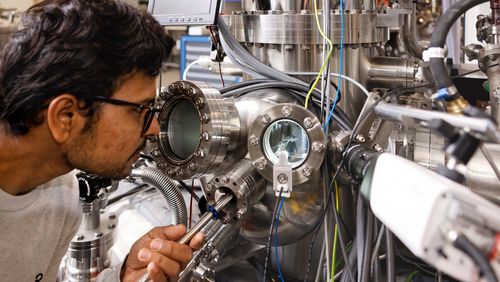
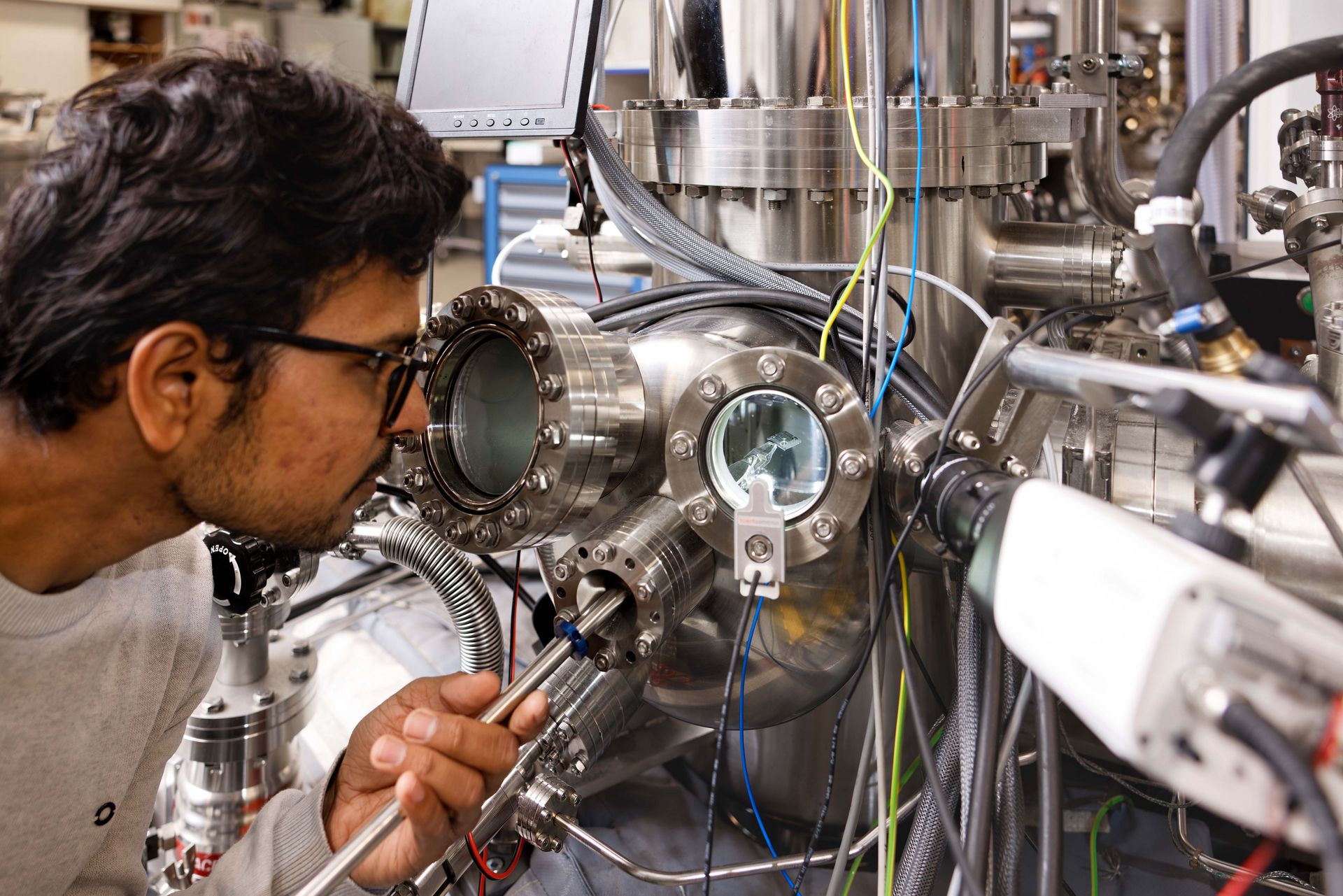
Meyer says that investigating the chemical molecules in various arrangements and studying current transport on different superconducting substrates are among the most important initial steps in the MolQ project. For these experiments, the researchers use scanning tunnelling and atomic force microscopes at the Department of Physics—some of which were built by the physicists themselves.
“But we’re approaching the limits of what’s technically possible with the electrical current measurements,” Meyer explains. To be sure, the in-house scanning tunnelling microscope can take measurements. However, he adds, “we’d have to seal the superconductor molecule sample with an insulating layer and conduct the measurements in a cryostat at one hundred millikelvin, and that under clean room conditions”.
A cutting-edge, novel scanning tunnelling microscope would offer the MolQ researchers more possibilities, and they’re currently exploring funding options. With the new device, the team wouldn’t have to work in a clean room and could dispense with the isolating layer, which complicates the experiments. In addition, they could measure transport levels at multiple points on the sample.
Diverse components possible
Initial investigations of chemical molecules on superconducting substrates have yielded positive results. And when the researchers tested various molecular arrangements, they observed fascinating effects. “Depending on how we group them, the molecules develop different electronic properties,” Meyer relates. “We already see that we can produce the various components that are essential in a computer.”
One example is the simple linear arrangement of several molecules. “In these rows, the molecules behave in such a way that we can use them as storage elements,” Meyer says. And when the researchers arranged the molecules in triangles, something completely unexpected happened: when the voltage was increased to a certain range, the electric current suddenly dropped—an unusual effect, as most materials exhibit increasing electric currents with increasing voltage.
“This phenomenon could be useful for creating resonant circuits,” Ernst Meyer says. A resonant circuit is an electric circuit that periodically generates electric vibrations. Such components are also essential for qubits in a quantum computer, Meyer explains. “For example, we’ll need very high clock rates.”
It’s safe to say the MolQ project is off to an excellent start. It will be interesting to see what other surprising discoveries the researchers make in their pursuit of novel, molecular quantum electronics.