


Eco-friendly
chemistry with light
Biomass instead of petroleum: researchers in the working group led by Benjamin List at the Max-Planck-Institut für Kohlenforschung have engineered a chemical reaction that converts bio-based molecules into high-value commodity chemicals—in a single step. The method could help pave the way to a sustainable chemical industry.
The chemical industry is on the verge of a fundamental turning point: in future, biomass-derived feedstocks could replace the petroleum-based materials that are currently used almost exclusively in the sector. A key player in this scenario is furan—a ring-shaped compound that can be harvested from biological materials such as wood or straw. Furans are generally seen as a kind of universal intermediate for producing many other chemicals. At present, however, they’re only suitable for industrial purposes if they’ve first been chemically altered, either through oxidation or reduction—which unfortunately consumes energy, generates waste and is at odds with the goal of an eco-friendly chemical industry.
Now, a team led by Benjamin List at the Max-Planck-Institut für Kohlenforschung in Mülheim an der Ruhr has achieved a breakthrough. In an article published in top-tier journal Science (*), the researchers describe a reaction that, in just a single step, converts furan into molecules that are highly useful in the chemical industry. “So-called photohydrolysis is what made our reaction possible,” says Nils Frank, PhD student in List’s team. In addition to being responsible for conducting a large part of the research, Frank also came up with the idea for the project.
For the reaction, the researchers add water, light energy and a photocatalyst to the feedstock, the furan. This initially converts the furan into an intermediate that then gradually breaks down into a linear molecule. One of the final products is succinaldehyde, which, as Frank explains, is a potentially new biobased commodity chemical for producing medications or plastics. By way of comparison: the cost-effective production of succinaldehyde using petroleum-based feedstocks is essentially impossible, as no fewer than five conversion steps are needed.
Surprising reaction pathway
The reaction works on many different furans and is at times extremely efficient—with some furan derivatives, the chemists attained yields of almost eighty percent of what is theoretically possible. However, Frank says the real surprise was the intermediate: a ten-membered ring consisting of two furan units—a structure that hasn’t yet been scientifically described. “At first, we didn’t believe we were actually dealing with this heterocycle,” Frank explains. “So we spent a year trying to disprove it using spectroscopy—but we couldn’t.”
The researchers also applied their approach to a group of furan derivatives called furfurals. “The concept is formally the same,” Frank says. However, the reaction doesn’t take place along the ten-membered ring, and different substances are formed in the end: molecules found in natural products that have an antimicrobial effect. These substances are extremely interesting for the pharmaceutical industry, as they could be used to make antibiotics. As in the production of succinaldehyde, several chemical steps are needed to produce these substances using conventional methods. But Frank emphasises: “Our reaction does the job in just one single step.”
Easily scalable
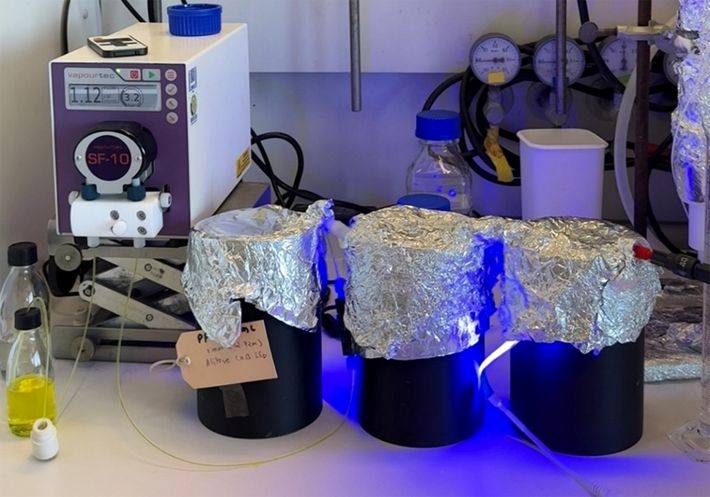
While it remains to be seen whether medicines or plastics will indeed be produced using the new reaction pathways, the researchers have already demonstrated that their photochemical method in principle functions on a larger scale. As part of the study, they developed a photochemical flow reactor in which the reaction solution is passed through thin tubes and exposed to uniform light irradiation. In this set-up, they found that several grams of the desired substance could be produced per day and cubic decimetre reactor volume.
For technical implementation and industrial production, however, further research is necessary, as Frank says: “First of all, we need to better understand the reaction. We want to find out what other products we could obtain.” In addition, it would be important to determine—and, if necessary, optimise—how much energy the process consumes. Another issue is less technical: Frank has the impression that industrial players currently lack the will to switch to biomass-based processes. “But when we chemists develop novel reactions to generate innovative products that can’t be attained via petroleum-based routes, businesses will at some point be interested.”
The power of light
What is the secret to discovering such completely new reaction pathways? In retrospect, Frank says, the idea is actually quite simple—and is probably down to the fact that organic chemists enjoy thinking about new reactivities. In this regard, Frank says he realised that redox-neutral reactions (reactions without the acquisition or loss of oxygen) have previously been given short shrift in biobased chemistry. He adds that many biologists and technical chemists working on the conversion of biomaterials have the tendency to focus on processes rather than the essence: the molecule and the atoms.
Benjamin List agrees. Chemistry with photocatalysts is in vogue, he says, “But many people haven’t yet fully realised the power of light in chemical reactions.” All the while, photochemistry enables thermodynamically unfavourable reactions that require energy input to work—reactions that chemists have generally believed to be impossible. List says it’s to Frank’s great credit that he tries his hand at such ventures.
High hopes for splitting CO2
This is also the link to the photocatalytic reduction of CO2, the main goal that Benjamin List is pursuing in the larger project, which is financed by the Werner Siemens Foundation (WSS). While List concedes that the conversion of furan is very different to splitting carbon dioxide, he also points to significant similarities. For example, one aspect of the WSS project is the creation of solar carbon via artificial photosynthesis, with the aim of using it to produce fine chemicals. “In the reaction described here, we’re initially still using natural photosynthesis,” List explains. Their reaction product—biobased carbohydrates—is used to produce furans, which the researchers subsequently convert into fine chemicals via artificial photosynthesis.
And there are other similarities: both CO2 cleavage and furan photohydrolysis are so-called uphill reactions that require energy input. Indeed, quite a bit of energy is needed to split the intermediate state—the ten-membered ring—as Frank explains. The fact that it works makes him optimistic that they’ll be able to cleave CO2. “That’s the magic of photochemistry,” List adds. “Light transports an incredible amount of energy. Light makes everything possible.”
(*) Link to study