

A “quantum loupe” for examining spins
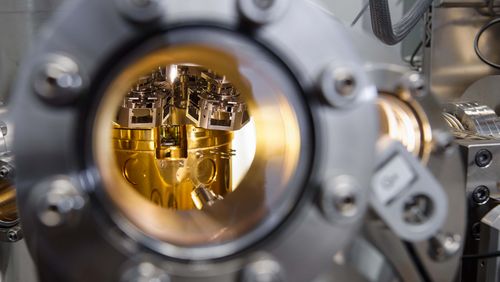
Thanks to funding from the Werner Siemens Foundation, physicist Yujeong Bae was able to upgrade two new scanning tunnelling microscopes last year, converting them into sophisticated “quantum loupes” for examining and manipulating the spin properties of CarboQuant’s made-to-measure graphene nanoribbons.
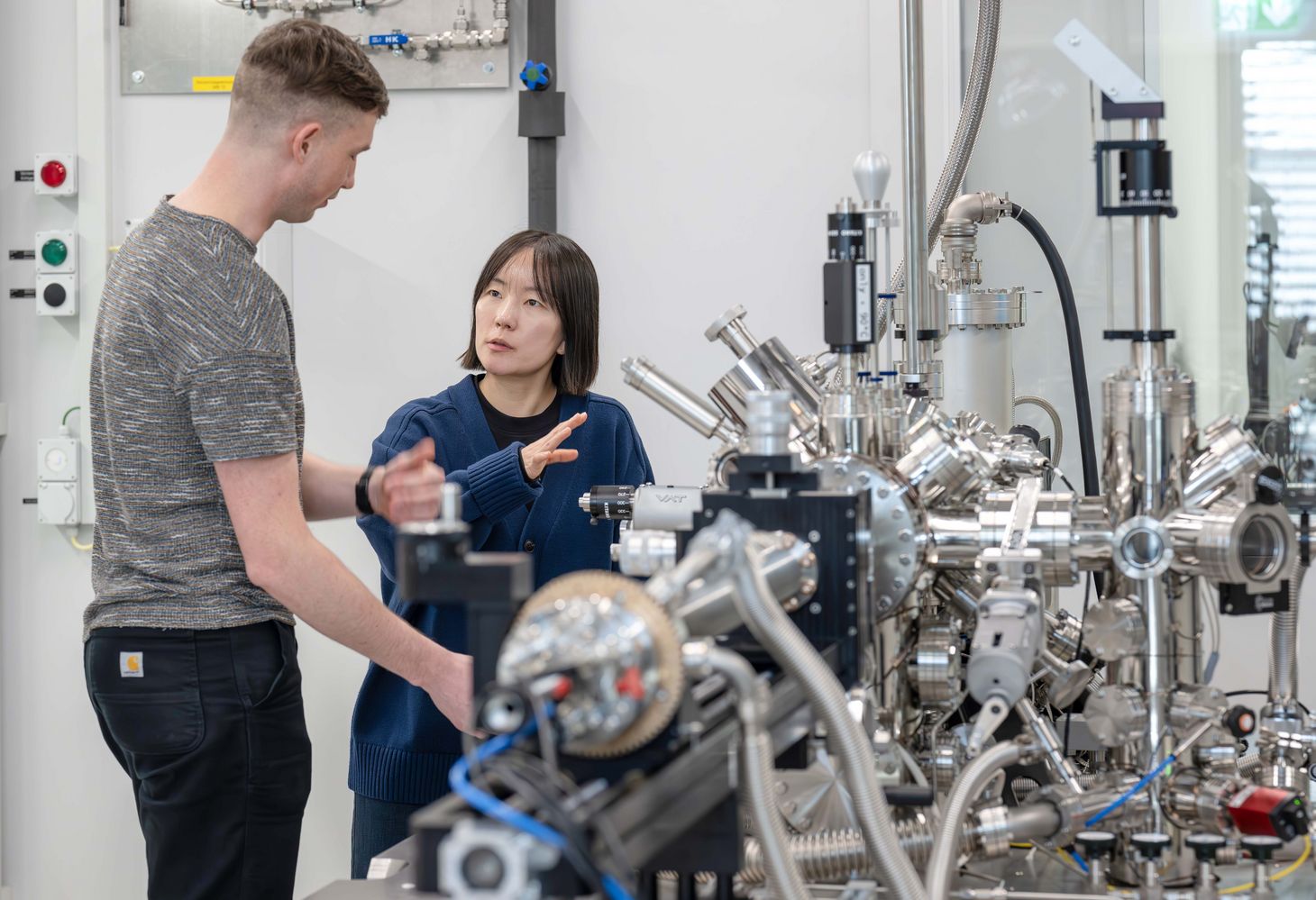
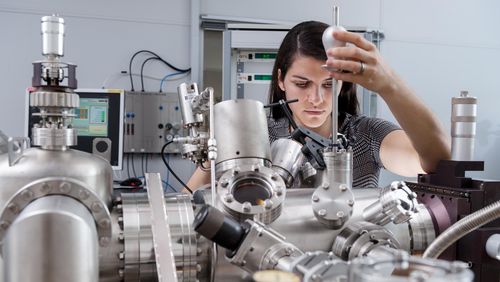
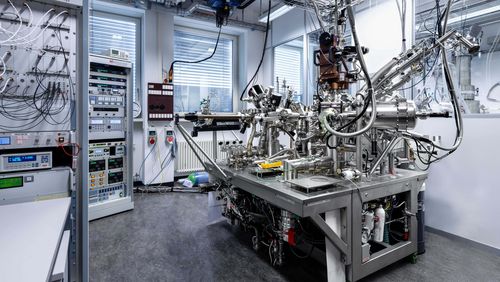
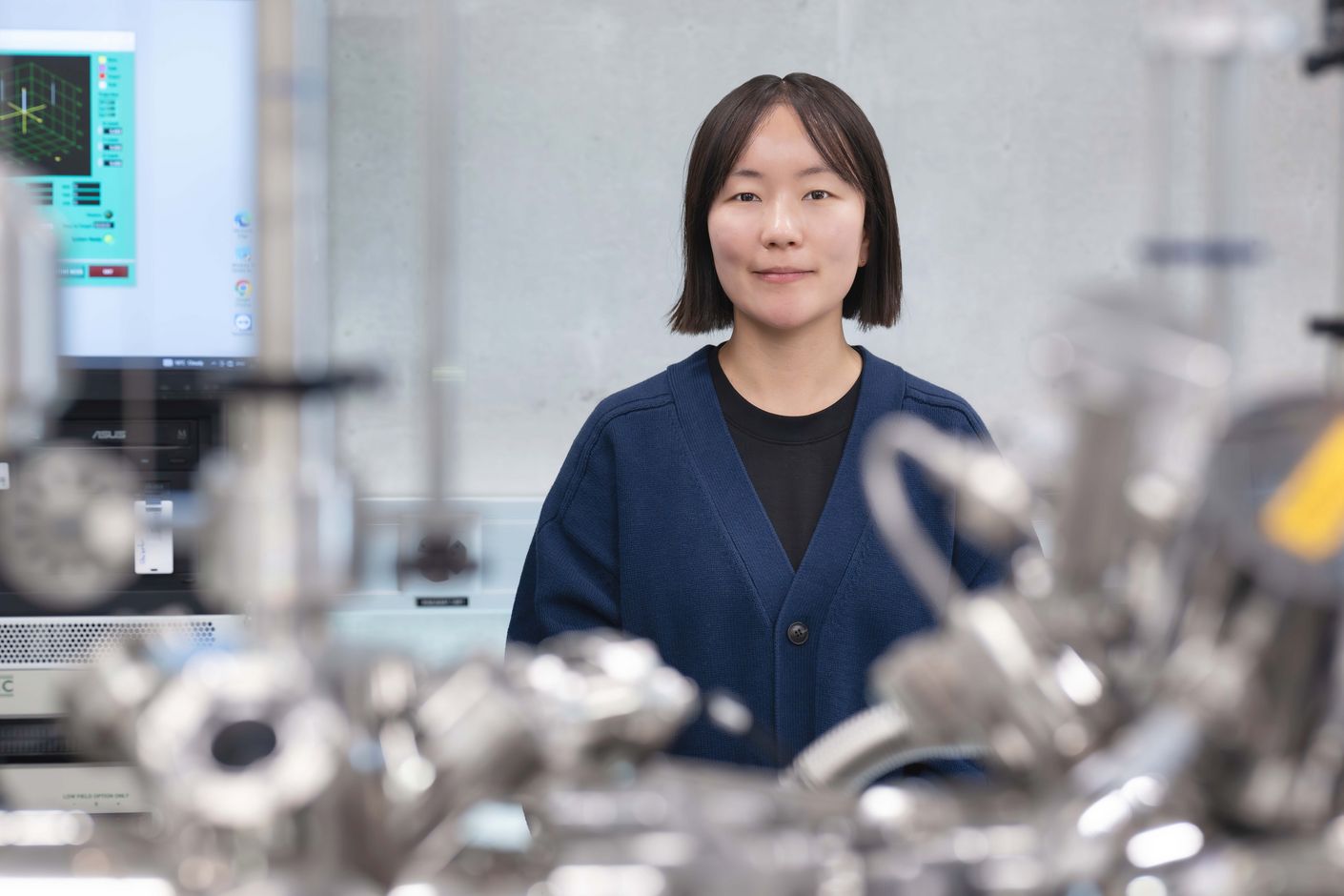
In June 2024, the quantum magnetism group of the CarboQuant team moved into their new lab at Empa in Dübendorf, Switzerland—just in time to set up two scanning tunnelling microscopes (STMs) that were purchased in part with funding from the Werner Siemens Foundation. Before the researchers could use the state-of-the-art equipment for their quantum experiments, however, the STMs had to be modified to meet their specifications. Responsibility for this highly complex task fell to South Korean physicist Yujeong Bae, who had joined the team in January 2024.
Yujeong Bae leads the research team for quantum magnetism at Empa’s nanotech@surfaces Laboratory, which is led by CarboQuant project co-leader Roman Fasel. Bae numbers among the world’s few STM specialists who not only know the intricacies of the device—but who can also use it to conduct complex experiments with individual spins on surfaces.
Unique competencies
Her expertise in both areas is what enabled Bae to transform one of the two new devices into a veritable “Rolls Royce” of scanning tunnelling microscopy in just four months—one that uses a highly precise and powerful scanning tip to create atomic-scale resolution images of nanomaterials.
The particularity of the upgrade is that electromagnetic waves with a frequency of several gigahertz are fed into the souped-up STM via a special cabling system. “Standard scanning tunnelling microscopes are unable to process microwaves that have such high frequencies,” Fasel explains.
But that’s not all. Indeed, the most important aspect of the new device is that it transmits microwaves to a small antenna, which then generates a microwave field between the STM’s scanning tip and the sample. “This is the only way we can use electron spin resonance to establish an interaction with individual spins and then manipulate them,” Bae explains. “It’s impossible to conduct these kinds of sophisticated quantum experiments using conventional scanning tunnelling microscopy.”
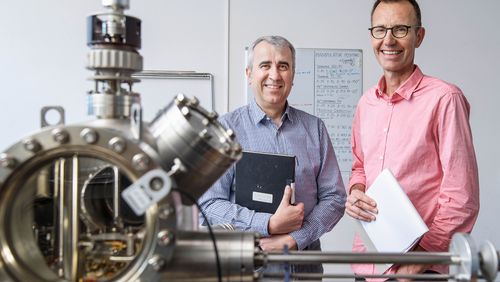
“The new devices represent a major milestone in the CarboQuant project,” says Oliver Gröning, co-leader of the WSS project. “In addition to realising the extremely complicated set-up of the STMs in record time, Yujeong has also demonstrated proof of concept for quantum experiments using one of our most important molecular structures.”
Although the second STM device is slightly less powerful, it’s more compact and is easier to operate. Bae is currently training researchers in the various CarboQuant groups to operate it and eventually conduct electron spin resonance experiments on their own.

Controlling individual spins
In summer 2025, the researchers began studying the graphene ribbons they’ve designed over the past ten years. Identifying the quantum mechanical properties of the materials is of particular interest, and the enhanced STM will enable the team to analyse and control each individual electron spin. “The knowledge gained in these experiments is absolutely essential for technological implementations,” Gröning explains.
The work has advanced so far that the various strands of the CarboQuant project can now be gradually brought together. The groups for materials development, electronic characterisation, atomic-scale simulation and STM quantum optics are working together to seek an optimised measurement strategy for studying a wide range of nanostructures with the new STMs—one that eliminates the need to make complicated and time-consuming adjustments. Bae greatly appreciates the interdisciplinary exchange with her colleagues: “It allows us to be very creative in how we pursue CarboQuant’s aims.”
In May 2025, Fasel’s research group announced yet another major success: they assembled nanographenes into a particularly clean realization of the one-dimensional homogenous Heisenberg quantum spin model and to make precise measurements of its properties. The authors of a “News & Views” article in top-tier journal Nature Materials believe the development opens the door to unlimited possibilities for designing and controlling quantum systems and will lead to even more breakthroughs.
Correlated magnetism
Another highlight, published in Nature Chemistry, was to follow in the summer, when CarboQuant researchers succeeded in binding organic porphyrin molecules (chlorophyll and haemoglobin are examples) with functional metal centres to one of their graphene nanoribbons. The resulting hybrid nanomaterial is very promising, as Oliver Gröning explains: “It exhibits both the special, delocalised magnetism of our carbon nanoribbons as well as the more conventional, localised magnetism of metal atoms.”
The correlated magnetism of these new nanoribbons holds great potential for quantum-technological applications in which the spin (the fundamental property that causes magnetism) acts as an information carrier—that is, as a qubit. And this is precisely what the CarboQuant leaders envision: “Our graphene nanoribbon combined with the porphyrins could function as a series of interconnected qubits.”