

The sun, the moon—and hydrogen
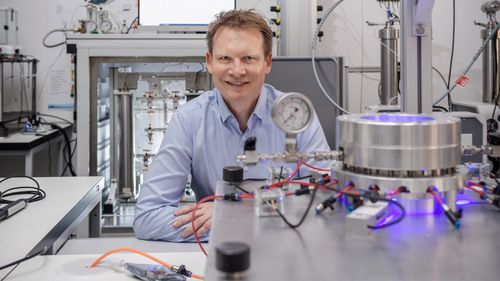
The research group led by Martin Saar at ETH Zurich has developed a simulator able to produce the most accurate-ever calculations on where geothermal energy projects could be financially viable. The researchers are also exploring whether tidal forces are responsible for the formation of hydrogen on our planet—a fascinating hypothesis.
Utilising deep geothermal energy requires much more than simply locating geothermal reservoirs. It’s also critical to determine whether the requisite—and costly—drilling and extraction operations are actually worth the investment. Answering such questions is one of the key competencies of Martin Saar’s Geothermal Energy and Geofluids (GEG) research group at ETH Zurich. Over the past several years, the GEG scientists have developed a simulator that takes the precision of such techno-economic assessments to the next level.
The new simulator goes by the name of TANGO (Techno-economic ANalysis of Geoenergy Operations), and it made its debut in the scientific community at the European Geothermal Congress
held in Zurich in October 2025. “TANGO can simulate thousands of different reservoirs, boreholes, power plants and optimisation scenarios,” Martin Saar says. “This information helps us identify the individual geological sites and specific configurations that will enable different types of geothermal power plants to compete with other energy forms.”
A principal area of application for the simulator is within the CPG consortium, a partnership Saar formed with companies such as Shell, Petrobras, Holcim and Ad Terra Energy in which the GEG researchers are investigating whether existing reservoirs could be used for a novel, innovative combination of carbon storage and geothermal energy production. Economic feasibility studies are a crucial aspect in the large-scale collaboration, and Saar says the first phase of this work is now complete. One of the goals in the next phase will be to identify a suitable reservoir for a demonstration project.
Custom-made MRI
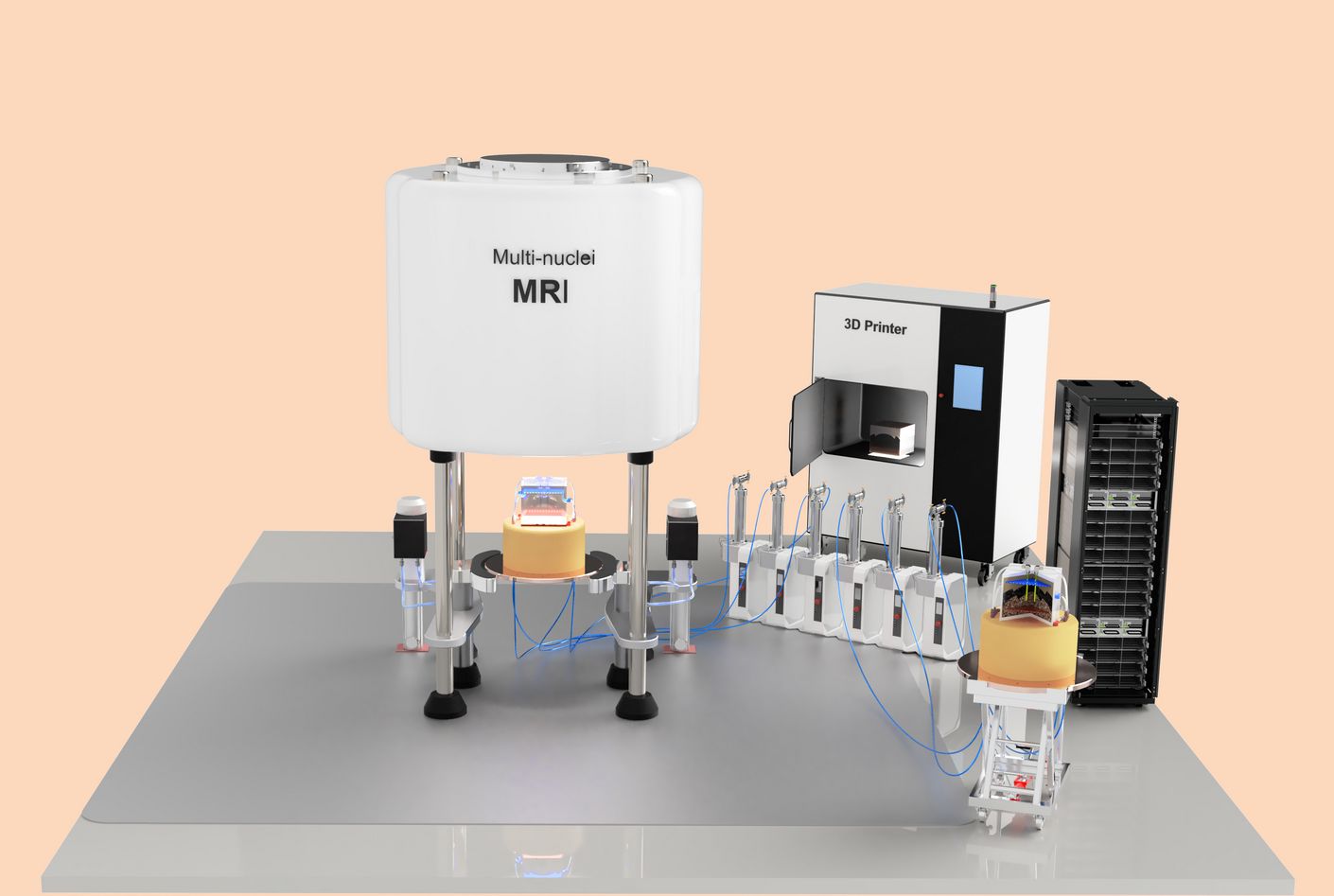
In parallel to this line of inquiry, projects that begun last year at the start of the new WSS funding period are picking up steam. The centrepiece of these endeavours is a unique, custom-made multi-nuclide magnetic resonance imaging (MRI) device. In the future, the researchers will use the new MRI to conduct geological and geothermal studies in rock models—studies that until now have been technically impossible.
In recent months, Adam Altenhof, the resident MRI technology expert in Saar’s team, has been developing the design and defining the specifications for the device, which a US firm is building to order. And although the tomography device will be comparatively lightweight for its kind, it will still weigh in at three metric tons, meaning the lab space will have to be redesigned to accommodate the massive scanner. “We spent nine months working with engineers, architects, stress analysts and electricians in order to obtain the building permit from ETH Zurich,” Saar relates.
Hydrogen in rock layers
Meanwhile, the researchers have already secured funding for the first experiments with their MRI device, one of which will be carried out as part of a project financed by the ETH Zurich Centre for Origin and Prevalence of Life (COPL). In their contribution, Saar and his team are seeking to understand how natural hydrogen is formed in the Earth’s crust—an intriguing topic, as it was long assumed there were no natural hydrogen reservoirs on Earth due to the gas’s extreme volatility and reactivity.
“Now, however, we know that deposits exist, although it’s not yet clear where and under what circumstances they form,” Martin Saar explains. He adds that there are various theories, and that he and his team will be putting one such theory to the test in their MRI—in an experiment designed to discover whether natural hydrogen is formed by solid-Earth tides (periodic displacements of the solid Earth’s
surface caused by the gravitational pull of the moon and sun) or tectonic processes that break up rock layers on Earth and other celestial bodies.
Radicals split water
The mechanical action of breaking up silicate rocks leads to the formation of free radicals, which are molecules with an unpaired electron. When free radicals come into contact with water, they can split it into hydrogen and oxygen—the two molecules believed to be essential for life to evolve on a planet, as Saar explains.
The new MRI is ideal for investigating these types of processes: in addition to detecting all atoms and molecules involved in the reactions, it can also image the free radicals—and that in 3D. “Inside the MRI, we expose the rock samples to the kinds of pressures and temperatures found in the Earth’s crust to fracture them,” Saar says. “At the same time, we inject water into the now semi-permeable rocks to visualise the formation of radicals and the conversion of water into hydrogen and oxygen in 3D over time.”
The experiment will not only help unravel the mysteries of natural hydrogen formation in the Earth’s crust and reveal how to best explore this carbonfree energy resource—it’s also a prime example of the fascinating questions the GEG group will be able to delve into with their new, one-of-a-kind MRI.