


An early warning system after operations
Post-operative complications are often difficult to detect. To change this, researchers in a new WSS project at the Balgrist University Hospital in Zurich are developing ultrasound-induced contrast agents to continuously monitor—and, if needed, even treat—deep post-operative surgical sites.
A surgical wound that heals poorly or an undetected infection that spreads slowly—post-operative complications and ailments often only make themselves apparent after some time. Indeed, despite the great advances made in modern medicine, it remains difficult to monitor processes taking place inside the body, let alone at the molecular level and in real time.
This is set to change, thanks to the “SonoGuard” project led by Inge Herrmann, head of the Ingenuity Lab at the Balgrist University Hospital in Zurich. Herrmann is also a professor at the University of Zurich, lecturer at ETH and research group leader at the Swiss Federal Laboratories for Materials Science and Technology (Empa). In the “SonoGuard” project, she and her team are developing a non-invasive system that can detect deep post-operative complications at an early stage—and even administer effective treatments. The Werner Siemens Foundation is financing the innovative research project with a total of eight million Swiss francs over the next five years.
“Every year, complications following medical interventions cause more than four million deaths worldwide,” Herrmann says, adding that adverse developments are particularly serious and difficult to detect when they occur deep inside the body. “A skin infection is frequently visible to the naked eye, but deep internal complications often become apparent only after they’ve already spread significantly.”

Novel contrast agent
Gastrointestinal operations—from the oesophagus to the rectum—rank among the most dangerous operations. Surgeons must often connect pieces of the intestine after sections have been removed or bypassed, which carries a high risk that a suture will fail to heal properly and begin to leak. Herrmann says this type of complication occurs in up to twenty percent of all oesophageal procedures, and that the rate increases to thirty percent in the case of operations on the pancreas.
As a result, digestive and gastric juices leak into the abdominal cavity. The initial symptoms are often nonspecific and difficult to distinguish from normal post-operative inflammation. Over time, however, they can develop into serious infections and even result in life-threatening sepsis. Unfortunately, current methods are often only able to detect the danger after an infection has progressed to the point where treatment options are limited—or it’s already too late.
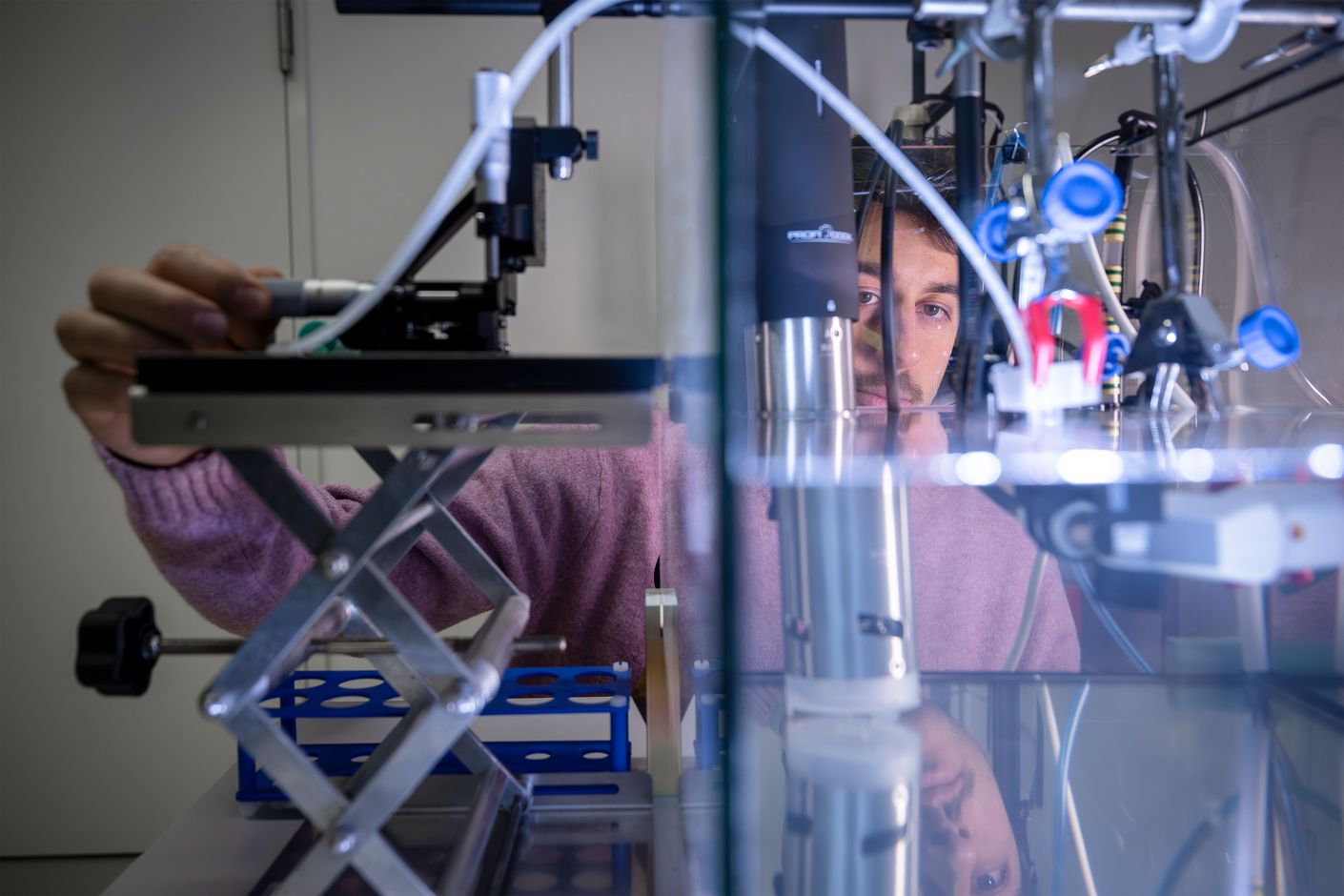
In the SonoGuard project, Herrmann and her team want to continuously monitor these post-operative surgical wounds using a clever technology developed by PhD student Benjamin Suter. The details are still secret, as patents are pending for several components and developments. However, Suter can divulge that the key part of the system is a novel contrast agent: “We’re using ultrasound to activate the contrast agent, causing it to emit a unique, disease-specific signal that’s clearly distinguishable from signals sent by the body’s own tissue.”

Triggered by gastric juices
Enabling their system to continuously monitor a specific part of the body involves several innovations. For instance, the researchers have developed a method to ensure that their contrast agent is activated in the body when a complication arises—but only then. “We add highly specific substances to the contrast agent so that it’s inactive, or ‘off’, in its basic state,” Herrmann explains. “The substances are prepared in such a way that they activate the contrast agent when pre-defined biological changes occur.”
In the case of leakage in the gastrointestinal tract, for instance, the presence of gastric acid would trigger the process. For this part of the project, the researchers can draw on quite a bit of preliminary work: in a previous project, they used a slightly different sensor approach to demonstrate that this type of acid-induced early detection of leaky sutures does indeed function.
However, the SonoGuard system is designed to do more than simply monitor healing and detect complications—in optimal cases, it will also be able to autonomously resolve any problems that arise. For this, the researchers are developing methods for integrating therapeutics such as antibiotics and anti-inflammatory drugs into their contrast agent. “Ultrasound can also be used to release these therapeutics as needed,” Herrmann says. “Our idea is to combine the early-warning system with non-invasive treatment delivery.”
Integrated into an adhesive plaster
A central question in the research project concerns how to place the contrast agent sensors so that they remain stable at a suture site for days or even weeks. Here, too, the team can build on previous findings. In an earlier project, the researchers created a hydrogel plaster that’s up to ten times more adhesive than conventional plasters, making it useful for effectively closing surgical wounds in the gastrointestinal tract. What’s more, the contrast agent can be integrated into the material.
Technological innovations notwithstanding, the defining feature of the SonoGuard system is its simplicity. “Rather than inserting electronic devices inside a patient’s body, we’re using simple, biocompatible materials,” Herrmann says. In addition, the system forgoes complicated methods for interpreting signals; instead, the researchers are developing a practical handheld device for this task.
Although Herrmann calls SonoGuard a “high-risk project”, she’s optimistic that the endeavour will meet with success. “We’re able to build on many important findings,” she explains. The technologies developed for the project already perform well in lab tests. However, as Suter points out: “Surprises are always possible when living organisms are involved.” New questions will also arise over the course of the project. For example: will the substances retain their stability inside the body? And: can the signals be read clearly even when a patient moves around a lot—or has a gastrointestinal ailment?
Ruling out side effects
A complicating factor in the project is that the physical environment in which the SonoGuard components will be placed is a medical terra incognita. Herrmann says we know what the main digestive enzymes in gastric juices are, but pH values in the stomach can vary from person to person and they’re also influenced by diet and the time of day. “To compensate for this, we examine secretions from the surgical wounds of patients and use the results to adapt our system to the variables.”
This procedure ensures not only that SonoGuard will function well for as many gastrointestinal patients with post-operative complaints as possible—it will also help prevent unwanted side effects. Because one thing is crystal clear: the system must not cause harm or additional problems. This is especially important, as the idea is to introduce the contrast agent directly into the body during all operations—including those involving patients who will never experience complications.

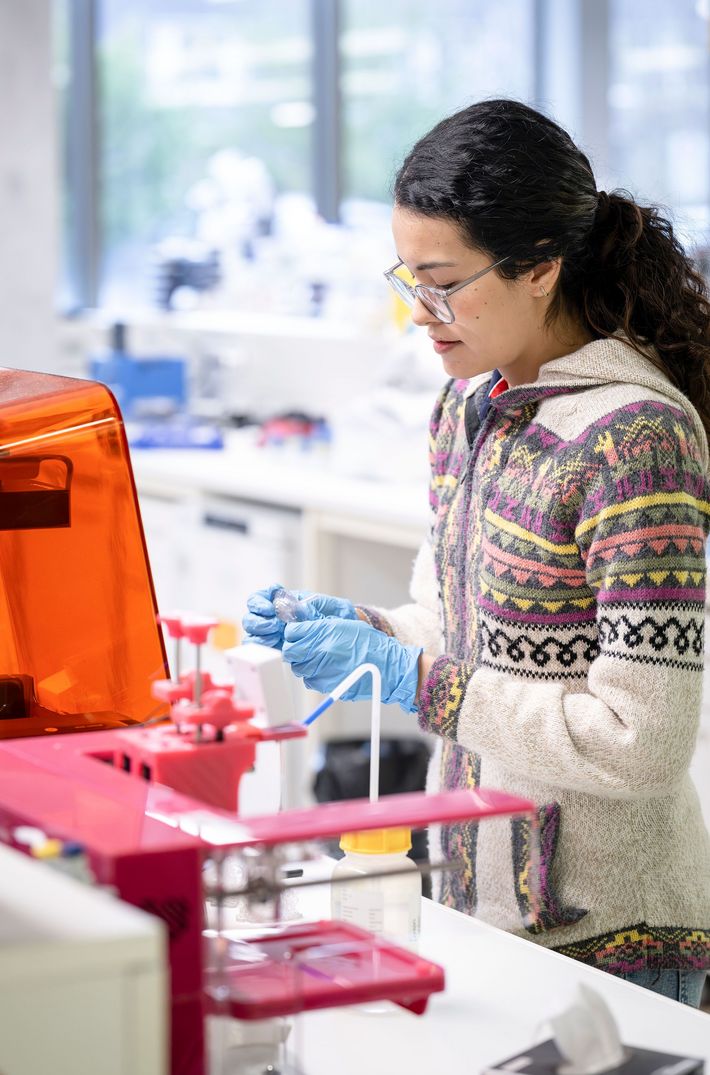
This early warning system inside the body would represent a major medical advance, and Herrmann says the team is working closely with surgeons. “This is key—we have to understand the needs of the people who will ultimately be using the system.” She adds that surgeons are generally very interested in SonoGuard. Which is perhaps unsurprising: aside from the health risks posed by post-operative abdominal leaks, gastrointestinal interventions also generate enormous costs—roughly forty thousand francs per patient.
Use in joint replacement
The SonoGuard team also envisions other applications for the system—to detect complications following joint replacement surgery, for example. Up to five percent of all patients develop an infection following such interventions, with the consequences ranging from simple pain and prolonged recovery on to tissue damage and the need for follow-up surgeries. In the most severe cases, infection may spread throughout the entire body or an amputation may be necessary.
There are also few reliable early-warning methods for implant-associated infections—and SonoGuard could be a viable option. However, Herrmann believes that developing a system for implants is likely more challenging than is the case of gastrointestinal leakage. “When gastrointestinal juices leak out of the digestive tract, it’s a clear indication that a complication is present. The situation is more complex with implant infections, as there are various pathogens and the relevant biomarkers have yet to be identified.”
The researchers have set themselves an ambitious pace in the SonoGuard project. Over the course of the first three years, they plan to further develop and optimise the sensor platform and the integration of therapeutics; this phase also includes establishing the most effective routes for administering medications and perfecting the related processes in the lab. During the second project phase, the researchers will ideally conduct experiments on living organisms to test their system—and develop a handheld readout device for use at a patient’s bedside.
Facts and figures
Funding from the Werner Siemens Foundation
8 million Swiss francs
Project duration
2025 to 2030
Project leader
Prof. Dr Inge Herrmann, Balgrist University Hospital, Ingenuity Lab, Zurich
