


Prodigy explores quantum worlds
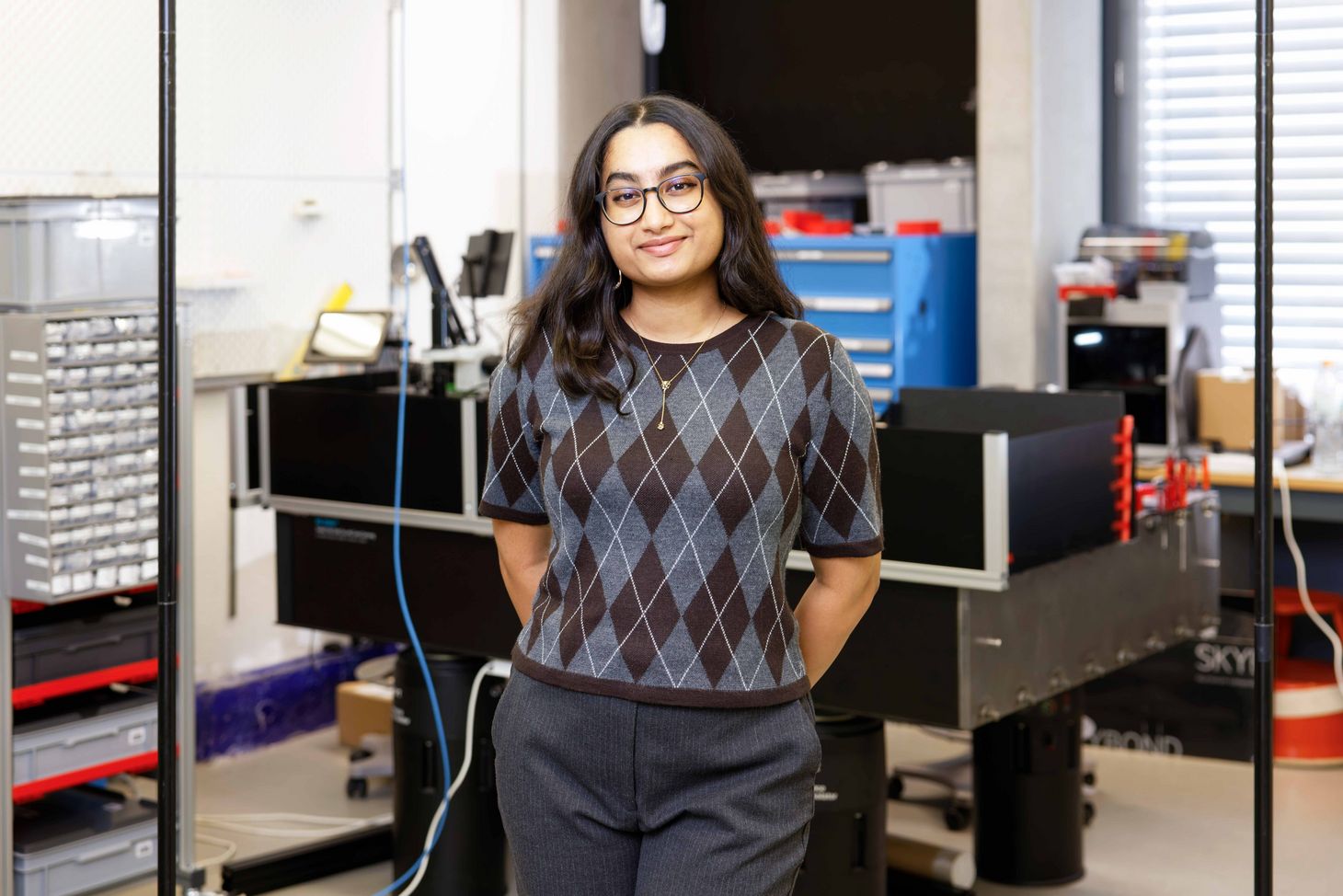
She earned her school-leaving certificate at the age of sixteen, her bachelor’s degree at nineteen. Now twenty-one years old, Ananya Amitabh is studying for a master’s degree in quantum engineering at ETH Zurich.Thanks to a Werner Siemens Foundation Excellence Scholarship, she can write her master’s dissertation abroad—and, in her spare time, encourage girls to study technical subjects.
It’s still relatively uncommon for young women to opt for a technical course of study. Ananya Amitabh is one of the few to do so—but her story also illustrates the obstacles young women face when taking this path. It’s not due to a lack of talent—which is abundantly clear in Amitabh’s case, given that she started school early and then skipped a year in primary school, so that she was a full two years younger than her peers when she received her school-leaving certificate from the upper secondary school in Zurich-Oerlikon.
Technical professions also run in Amitabh’s family, as it were, and both her parents are software engineers. “They taught me early on how exciting problem-solving can be,” the twenty-one-year-old says. This lesson played a major role in her decision to choose the maths-physics profile at school. “There were just four girls in our class,” she relates, adding that she was the only one of the four to later study a “hard” science or engineering. She says that without her parents’ example and encouragement, she might have made a different decision.
But what lies behind the reluctance of girls and young women to study STEM subjects (science, technology, engineering, mathematics)? Amitabh sees several reasons. For one, she thinks girls generally want to help people directly, which may explain why they choose the teaching profession or become doctors. “But a lot of girls lack the confidence to study natural or technical sciences. Or people don’t believe they can do it.” This was partially true even for Amitabh, who, at the age of just sixteen, was the best student in her school year. “One of my women teachers looked very surprised when I told her I was going to study electrical engineering,” she says.
Game-changing decision
In the end, Amitabh chose to study electrical engineering after experiencing the field first-hand: towards the end of her schooling, she attended an event for prospective students organised by the ETH Zurich LIMES association, which empowers women students in electrical engineering, IT and mechanical engineering programmes to network and support one another. “The electrical engineering lab tours really grabbed my attention,” she says. She believes events like this are crucial for encouraging more girls to study STEM subjects—in line with the motto: “You can’t be what you can’t see.”
The saying has accompanied Amitabh throughout her studies at ETH. “I discovered an entirely new world here,” she says, her eyes lighting up as she talks about the many professors—of both genders—who pursue fascinating research. She also finds the technical equipment and ideas for solving all kinds of problems inspiring. For her bachelor’s dissertation, Amitabh explored one such idea in the field of biomedical engineering: developing a microbotics-based method of delivering drugs directly to tumours via blood vessels. She says she was incredibly excited about the project.
Switch to the quantum world
After earning her bachelor’s degree—at the age of nineteen—she chose a different field of study for her master’s programme. This, because she had encountered something that inspired her even more: the world of quantum physics. The seed was sown during a quantum mechanics lecture she attended while studying for her bachelor’s degree. The quantum world began to fascinate her more and more: “The fact that a particle can be in two places at once has something mysterious about it. But at the same time, quantum mechanics is intuitive and elegant once you understand the underlying mathematical principles.”
Chance also played a role in her decision, as she got to know several students who were studying quantum engineering. “They were all so nice and they all seemed so happy that I told myself there must be something special about the subject.”
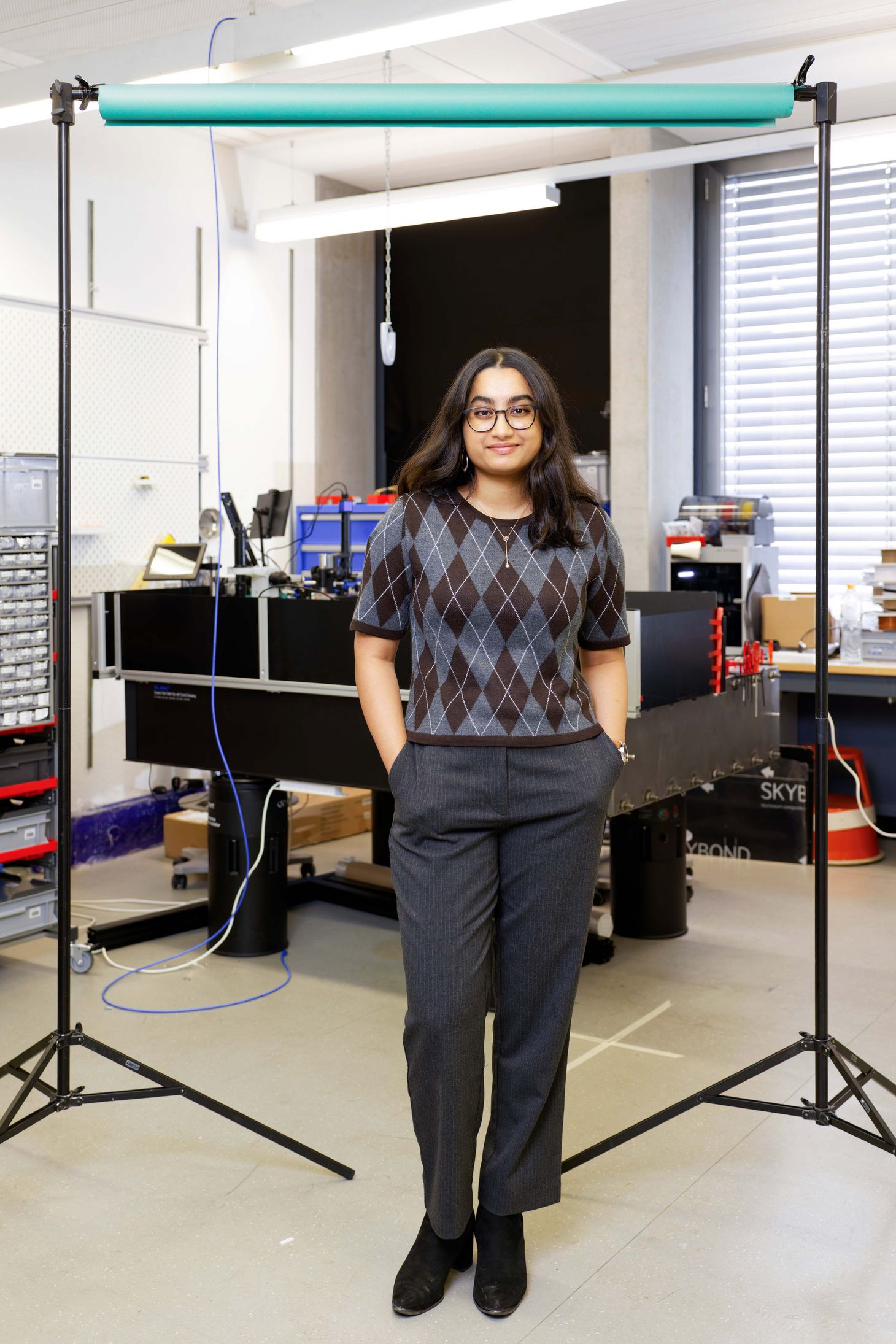
Today, she’s a student in the master’s degree programme for quantum engineering—and she herself conveys a deep sense of contentment. She says the programme has fully met her expectations and that the atmosphere is fantastic. “There are about thirty students in my year. We all know each other and we spend a lot of time together.” One downside, she admits, is that the age difference is more noticeable than it was during her school days. Now, the other students are generally three to four years older, as not everyone completed their bachelor’s degree programme in three years. Nevertheless, she feels welcome: “Everyone is very supportive.”
Quantum technology for medical care
Of course, the content of her new study programme is also a never-ending source of fascination. Quantum engineering involves more than just an understanding of quantum physics; it also encompasses the development of new quantum applications. The fact that such applications require an interdisciplinary approach is right up Amitabh’s street. She says she hasn’t lost her interest in electrical and biomedical engineering, and that she began thinking about how quantum electronics could be used in biomedical applications already at the start of her master’s programme.
Within the field of quantum technology, her main interest is quantum sensing. Here, quantum mechanical phenomena are utilised to perform a wide range of ultra-precise measurements. One promising method for creating quantum sensors is based on so-called NV (nitrogen vacancy) quantum systems, as Amitabh explains. These quantum systems are created using point defects in artificially produced diamond lattices.
These systems can be used to measure even the subtlest magnetic fields, and Amitabh intends to incorporate this feature into the next chapter of her studies. She says a research group in Cambridge (UK) is developing medical applications on the basis of NV quantum systems, and she plans to write her master’s dissertation there. “I’m coming along at the exact right time,” she says, explaining that hubs for research groups specialising in biomedical quantum sensing are a very recent development.
Studies abroad thanks to WSS fellowship
The Werner Siemens Foundation Fellowship that Amitabh received from the Swiss Study Foundation last summer has also come at the right time. The fellowships, which are awarded annually to ten outstanding students in STEM subjects, medicine or pharmaceutical sciences, are excellence scholarships that enable ambitious and gifted young people to focus their energies on their education and their personal and professional development.
Amitabh says the WSS fellowship is a huge help: “Thanks to the grant, I can write my master’s dissertation abroad without having to give up my extracurricular activities to earn money.” Indeed, Amitabh pursues numerous interests outside her studies. For example, she began practising karate when she was seven years old, earning her black belt by the time she was thirteen, and has been teaching children the martial art for the past five years.
Vital networks for women
However, her main extracurricular interest lies in encouraging girls and young women to study a STEM subject. As part of this work, she has led electronics workshops for children and teenagers at “mint & pepper”, a project of the Wyss Zurich Translational Center. “We assembled circuits for an electric city that had run out of electricity,” she says. “Seeing how delighted the kids are at the end is a great feeling.”
During her bachelor’s degree programme, she also began working at LIMES—the association whose information event made such a difference in her life. She first contributed by taking on organisational tasks before becoming a member of the board. LIMES organises monthly meet-ups as well as information days for schoolgirls, mentoring services and lab tours. Amitabh says the purpose goes beyond helping girls decide what to study: “It’s particularly valuable to offer young women in male-dominated subjects a space to get to know each other and enter into conversation.”
Such opportunities are essential, as women are still not always taken seriously in these fields. Here, she speaks from personal experience: a male classmate once told her she had only been offered a position as a student assistant because she’s a woman. “When you hear something like that directly, at least you can speak up for yourself,” she says. Often, however, the same message is conveyed in more subtle undertones. “At women’s events, we realise that other women have had similar experiences. At least we know it’s systemic, and not personal.”
Dreaming of a start-up
Amitabh is also very active in a second organisation: the Quantum Engineering Commission (QEC), the student association for the quantum engineering degree programme. “QEC is the glue that holds us together,” she says. There are organised events like hikes, barbecues and excursions to quantum research institutions as well as a Paper Club where published articles are presented. This semester, Amitabh acted as QEC president.
When she begins writing her master’s dissertation, however, Amitabh will have to step away from some of these activities. She intends to use her time in Cambridge to think about ways to serve in future—and to plan her professional future. She’d like to complete a doctorate, she says, but she first hopes to gain experience working at a quantum technology start-up, as this would be useful for writing a PhD thesis. Because her aim isn’t simply to delve into an interesting research question—she also wants to solve problems, just as her parents taught her. “It would be an absolute dream to develop my own product during my doctoral studies and then found a start-up.”


![[Translate to English:]](/fileadmin/_processed_/6/d/csm_02-WSS-News-Flora-Chiper_01_7d2e2c4805.jpg "[Translate to English:]")

![[Translate to English:]](/fileadmin/_processed_/7/b/csm_WSS_08_News_Rahel_Schmidt_2479bedc21.jpg "[Translate to English:]")