



Post-operative monitoring system
SonoGuard
Despite the advances made in modern medical care, complications after surgery remain common. To change this, researchers in the SonoGuard project at Balgrist University Hospital in Zurich are developing a non-invasive method that uses novel, ultrasound-induced contrast agents to quickly detect—and even treat—post-operative complications deep inside the body.
Articles about the project
The project in brief
Researchers in the SonoGuard project at Balgrist University Hospital are developing a surgical wound monitoring technology for the early detection of post-operative complications—be it poor healing following a gastrointestinal intervention or a serious infection after knee replacement surgery.
Worldwide, more than four million people die every year due to complications arising from medical interventions. Such adverse developments are particularly problematic and difficult to detect when they occur deep inside the body—unlike skin infections, which are generally visible to the naked eye, deep internal complications often only become apparent after they’ve spread significantly.
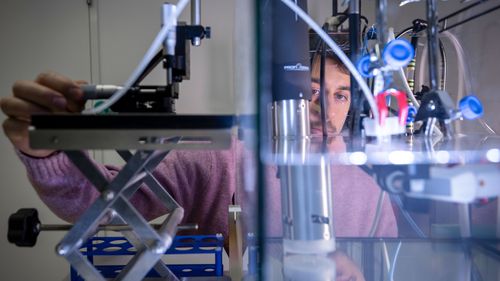
In the SonoGuard project, a team led by Inge Herrmann at the Ingenuity Lab at Balgrist University Hospital in Zurich is creating a system for continuously monitoring post-operative healing. The project is based on a clever technology developed by Benjamin Suter, one of Herrmann’s PhD students. At the heart of the project are novel contrast agents that emit a unique, disease-specific signal when stimulated via ultrasound.
To put their system into practice, the researchers are working on various innovations. For instance, it’s critical that the contrast agents are easy to place at a surgical suture, where they should remain—physically and chemically stable—for several weeks. The key to the SonoGuard solution is the integration of the contrast agents into a special hydrogel plaster. In addition, highly specific substances are added to ensure that the default state of the contrast agents is inactive or “off”: they should only switch “on” in the presence of biological changes caused by complications such as gastrointestinal leakage.
The most compelling feature of SonoGuard is its simplicity. Rather than implanting electronic devices into the body, the system utilises safe biocompatible materials. And the researchers’ solution for reading the signals does entirely without complicated and expensive technology: they’re currently engineering a handheld readout device for use at a patient’s bedside.
Facts and figures
Project leader
Prof. Dr Inge Herrmann, Balgrist University Hospital, Ingenuity Lab, Zurich
Project
Projekt
Funding of the Werner Siemens Foundation
8 million Swiss francs
Project duration
2025 to 2030