

The Alps as a heat reservoir
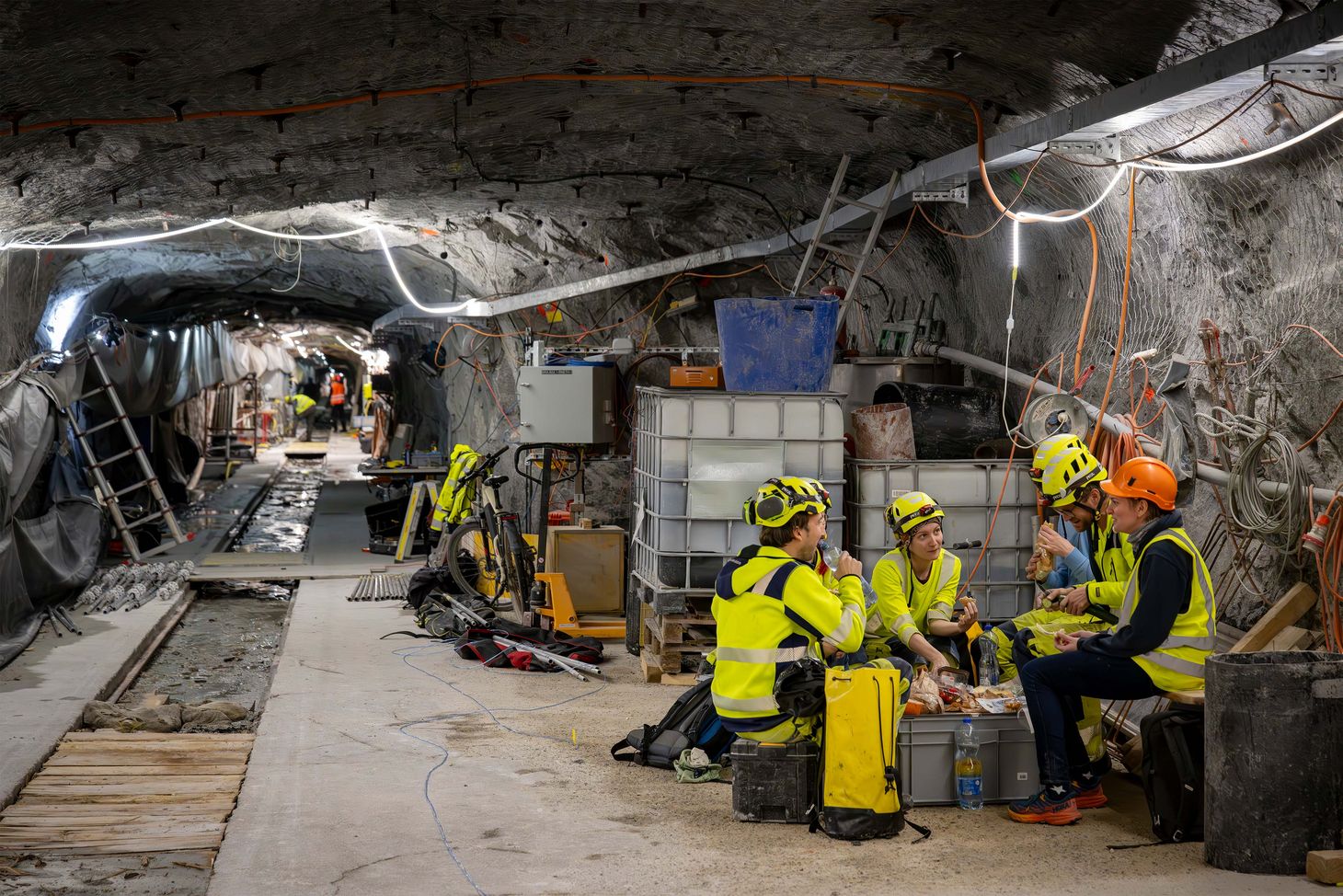
Last year, a unique pilot project for exploring seasonal heat storage in granite was launched in the BedrettoLab. In addition, a new side tunnel located near a fault zone in the Saint-Gotthard Massif is now being used for experiments to advance our understanding of earthquakes—while researchers from fields as diverse as geobiology and particle physics are also using the underground lab for their studies.
Last summer, a group of distinguished visitors—senior members of the Swiss Federal Office of Energy—arrived at the BedrettoLab to tour the underground facilities and learn more about the BEACH (Bedretto Energy Storage and Circulation of Geothermal Energy) project led by ETH Zurich professor Martin Saar. Underground energy storage is BEACH’s primary objective—specifically, the aim is to store energy in crystalline rock (granite) to compensate for seasonal fluctuations in energy demand. Over the past five years, all the necessary data to realise the aim have been collected. “Thermal energy accounts for a large proportion of Switzerland’s energy balance,” says Domenico Giardini, director of the Bedretto-Lab. “We believe that storing heat in granite could enable Switzerland to achieve the energy transition.”
Interest in the BEACH bench test—the only one of its kind in the world—is correspondingly high. Like other federal and cantonal electricity producers and their counterparts abroad, southern Swiss power company Azienda Elettrica Ticinese (AET) believes BEACH has great potential—and has proposed a pilot project for a robust, independent energy system for the Bedretto Valley that combines energy output from regional river, wind and solar power plants with heat storage in granite. The idea is to use the resulting mix of electricity and heat storage locally. “These types of combined and decentralised energy systems represent the future of power supply,” Giardini says.
Largest geothermal reservoir
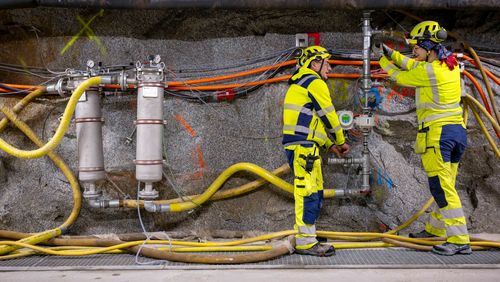
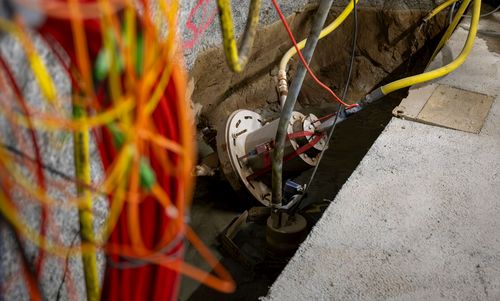
The BedrettoLab now has a fully moni-tored reservoir with a volume of more than two hundred thousand cubic metres—the huge granite mass located beneath the Bedretto tunnel. The rock here is riddled with fine fissures through which water can circulate, and it was transformed into a permeable reservoir via water injections. The researchers introduce just enough additional water into the rock to ensure that only minor earthquakes occur and that the water heats up quickly in the mountain’s hot interior. “We don’t break up the rock,” Giardini is keen to emphasise. The water makes its way through the fissures—no less than two thousand sensors have been installed to monitor every reaction triggered in the rock. When the heated water is designated for generating energy, it’s channelled back to the tunnel’s surface through a second borehole.
The new geothermal reservoir is scheduled to operate on a seasonal cycle over the next four years: in summer, warm water will be injected into the rock for storage, and this energy can then be utilised in the winter months. “Our model works,” Giardini says. “We’re now testing the system under real conditions to see how much heat we can draw from the reservoir in winter.” In particular, energy balance and storage efficiency, are being tested, and monitoring and modelling systems are being further improved. The economic feasibility of underground energy storage also forms part of this work.
Earthquake research in a side tunnel
In spring 2025, the new one-hundred-and-twenty-metre side tunnel branching from the main BedrettoLab was opened. Running parallel to a tectonic fault zone in the granite, the new testbed offers ideal conditions for studying earthquakes—hence the somewhat alarming project name: Fault Activation and Earthquake Rupture, or FEAR.
Thanks to the boreholes in the side tunnel, it’s possible to get very close to the fault zone; several boreholes even penetrate the fault itself. The singular set-up enables the researchers participating in the international FEAR consortium to address the many still unanswered questions about how earthquakes unfold. Domenico Giardini is satisfied: “This work is generating entirely new insights.”
Geobiology and particle physics
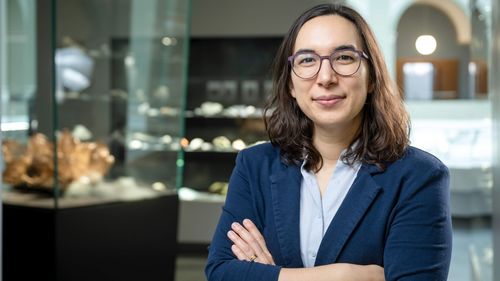
Since 2023, Cara Magnabosco, professor of geobiology and associate director at the ETH Zurich Centre for Origin and Prevalence of Life, has also been conducting her research in the BedrettoLab. Her aim is to discover elements that are essential for life to emerge. Because zones in the BedrettoLab have remained completely sealed off for millions of years, the lab’s deep rock layers represent an ideal location for exploring such questions.
In another venture, a cavern in the BedrettoLab will be converted into a unit for conducting particle physics research in 2026; the group led by Professor Björn Penning at the University of Zurich, will take the lead. The physicists want to detect elementary particles in the underground lab that originate from outer space in order to study dark matter, which constitutes most of the universe’s total mass. Giardini explains that only particles like neutrinos or muons can penetrate the kilometre-thick granite layer to reach the BedrettoLab.
Last but not least, the long-term financing of the BedrettoLab was also addressed last year. The ETH Board placed the unique underground lab on its list of large research infrastructure projects of national importance, and submitted a funding recommendation to the federal government.