

Trial by fire
Last year, the success streak at the Innovation Center for Deep-Sea Environmental Monitoring continued unabated. First and foremost, the SPIRULA monitoring system mastered tests conducted in the Mediterranean. And the MARUM team took up quarters in the new Center for Deep-Sea Research.
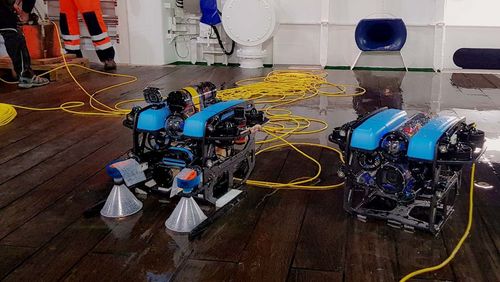
By spring 2025, work on SPIRULA (SPiraling Intelligent Robotic Underwater monitoring pLAtform) had progressed so far that MARUM professor Ralf Bachmayer and his team were ready to test their underwater monitoring system at sea. Software engineers Ankita Jadhav and Monja Daub had recently joined Bachmayer’s group to bolster the division for sensor data processing and electronics, and the now six-member team wanted to learn whether SPIRULA would function in a real-world setting outside the MARUM maritime testing pool—and whether the electronic modules built into the SPIRULA vehicle would successfully maintain communication with the monitoring node (the “lander”) positioned on the ocean floor.
From testing pool to open sea
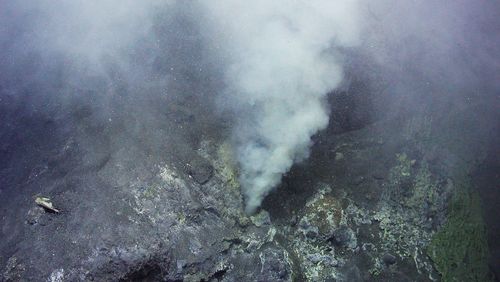
The Greek island of Milos was chosen as the testing site due to the presence of a magma chamber located some seven kilometres beneath the island, which forms part of the Aegean Volcanic Arc. Bachmayer’s team is particularly interested in the hydrothermal activity fuelled by the chamber, especially its gas emissions.
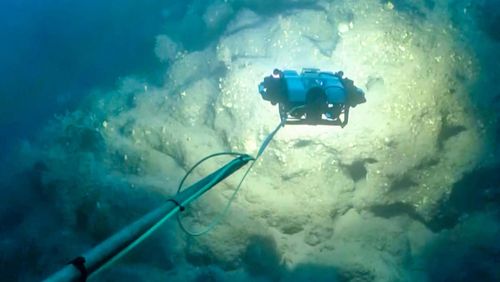
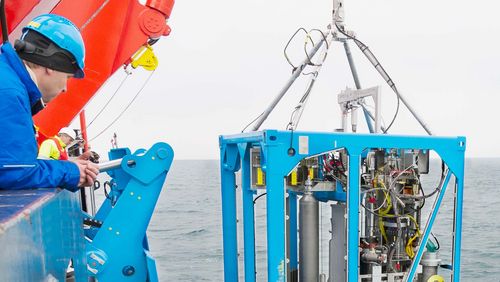
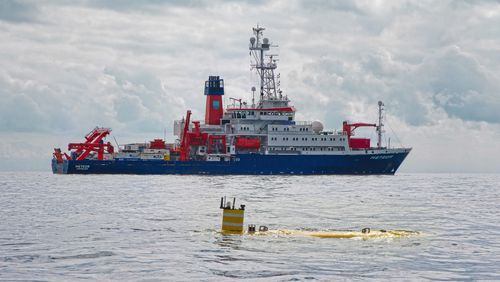
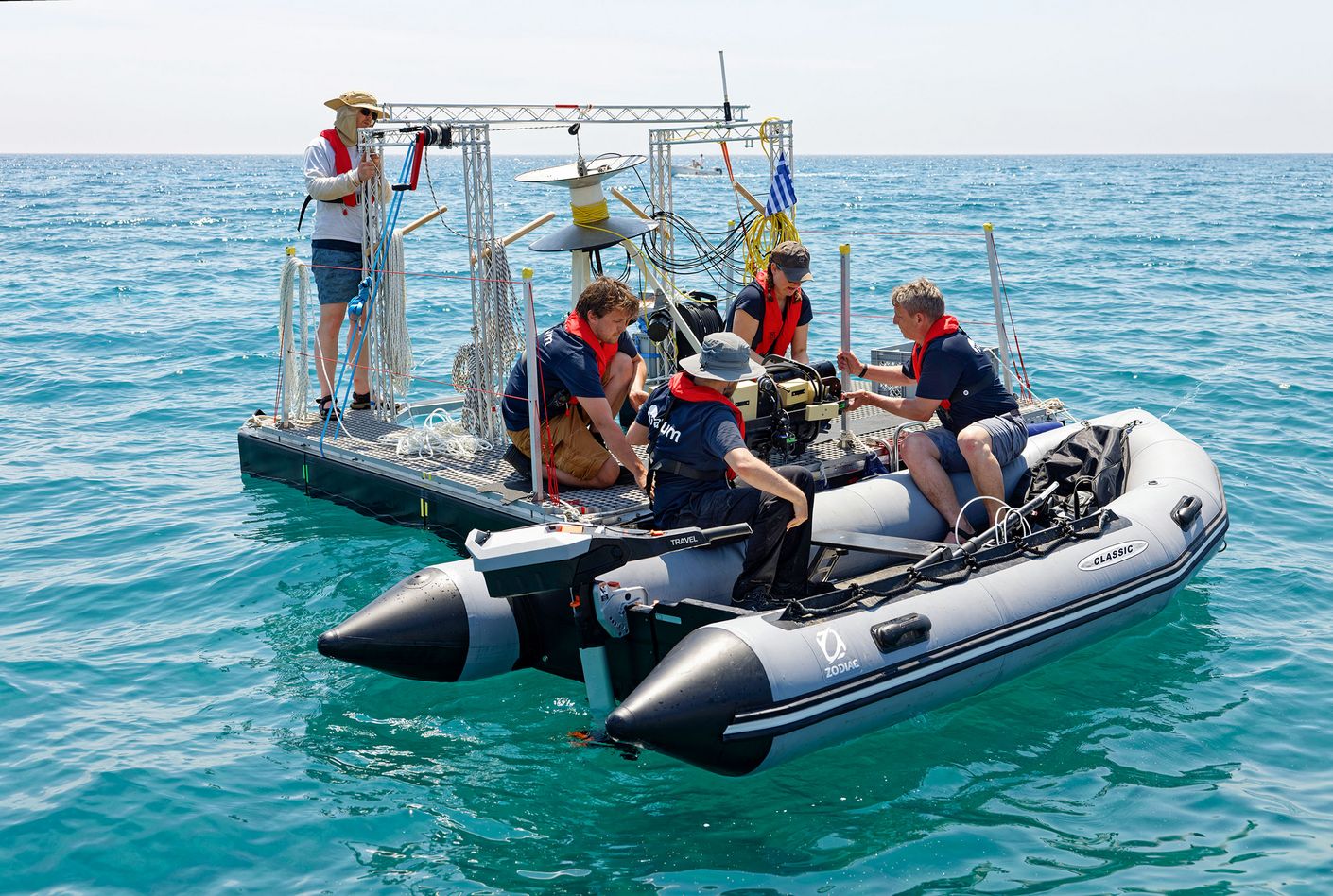
The journey from Germany to Greece took two days, and the team spent a further two days on the island preparing their equipment before all systems were ready at the end of April. The entire SPIRULA system was then placed on a custom-made floating platform and towed out to sea. After the lander was lowered about ten metres and anchored at one of the numerous underwater bacterial mats near the coast, the vehicle—which was secured and connected to the lander via a cable—unspooled itself and began to move over the seabed to record data, mastering waves, currents and cold temperatures in the process.
The engineers were exceedingly pleased with how the system performed. The complex operational mechanisms and technical elements of the two interlinked SPIRULA components functioned smoothly: the camera took high-resolution images of the environment and ocean floor; the multi-beam sonar recorded acoustic data of seafloor and environment; and the various sensors measured the water’s temperature, pressure, conductivity and turbidity as well as fluorescence levels.
Time-stamped data
The SPIRULA system delivered clean data, devoid of all electrical noise or other interference. “The quality of the collected data is high, which was our primary objective,” is how Ralf Bachmayer sums up the tests. Indeed, because all data and images have been time-stamped, they can be analysed either individually, in specific combinations, or as a whole, depending on what is being studied. Accurate time stamps are essential, as they enable identification of the cause of sudden changes in the measurements in the data record—an increase in water
temperature, for example.
“The successful tests at Milos represent a milestone in our work” says co-project leader Michael Schulz. “The built-in modules are independent systems that first had to be trained to communicate with each other.” He goes on to explain that the devices’ sensitivity to disturbances in the ocean environment is a complicating factor: “It’s not a simple plug-and-play system, and the fact that the technical equipment worked in the real-world setting is a major achievement.”
Uniting technology and research
Two other MARUM researchers were also involved in the tests at Milos: Solveig Bühring, a hydrothermal geomicrobiology specialist, and Christian Meurer, a postdoc studying monitoring methods for carbon capture and storage systems in the ocean floor and one of the principle designers of SPIRULA. They and other MARUM researchers would like to use SPIRULA for projects such as the long-term observation of vulnerable species communities living on the ocean floor. Given the myriad possibilities, SPIRULA’s potential uses for future research were unsurprisingly the subject of animated discussions after Bachmayer and his team returned to Bremen and the new Center for Deep-Sea Research.
New “Center for Deep-Sea Research”
To further cultivate the transfer of knowledge between research and technology, a new facility was built at the University of Bremen to host its various deep-sea research groups under one roof. In addition to standard workspaces, the new Center for Deep-Sea Research (ZfT) houses high-tech labs and an equipment hall for maintaining and further developing seagoing devices like the SPIRULA system. Bachmayer’s team moved into their new quarters at ZfT in April 2025.
Michael Schulz says closely coordinating deep-sea research and the development of the necessary technologies and equipment has been a hallmark of marine sciences at MARUM since the very start. “Innovative underwater technology is what enables deep-sea research in the first place,” the former MARUM director says with conviction. “The achievements made in Ralf Bachmayer’s group will now flow into future research designs.”