

Taking it to the limit
Over the course of an eight-year funding period, researchers at the Center for Single Atom Electronics and Photonics developed a single-atom switch that sets new standards for energy performance in electronic devices. In a follow-up project, the teams at ETH Zurich and the Karlsruhe Institute of Technology are now setting their sights on the lowest physically possible limit of switching energy.
The internet, artificial intelligence, autonomous vehicles—information technology is changing the way we live. At the heart of this massive sea change is one miniscule component: the transistor. This central building block of logic circuits is what enables an electrical current between two electrodes to be controlled via an independent third electrode.
It’s almost impossible to appreciate how ubiquitous this component is. The microprocessors containing several trillion transistors used for a wide range of AI applications are just one example. And although advances made in the past decades have seen transistors made of semiconductor materials like silicon become incredibly small, global energy consumption for data processing has nonetheless increased steadily due to the exponential growth in demand for electronic devices.
World record—for now
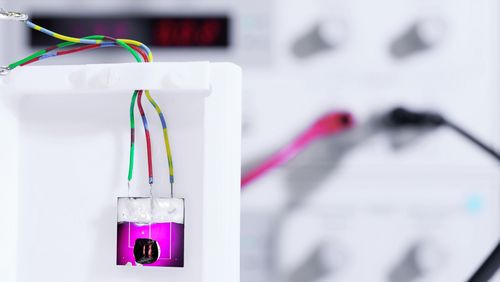
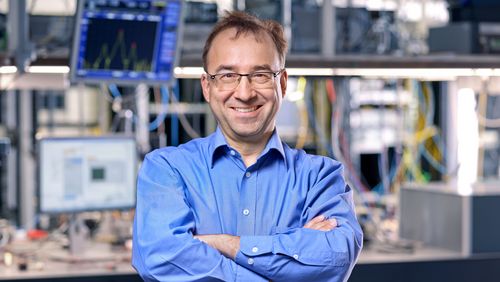
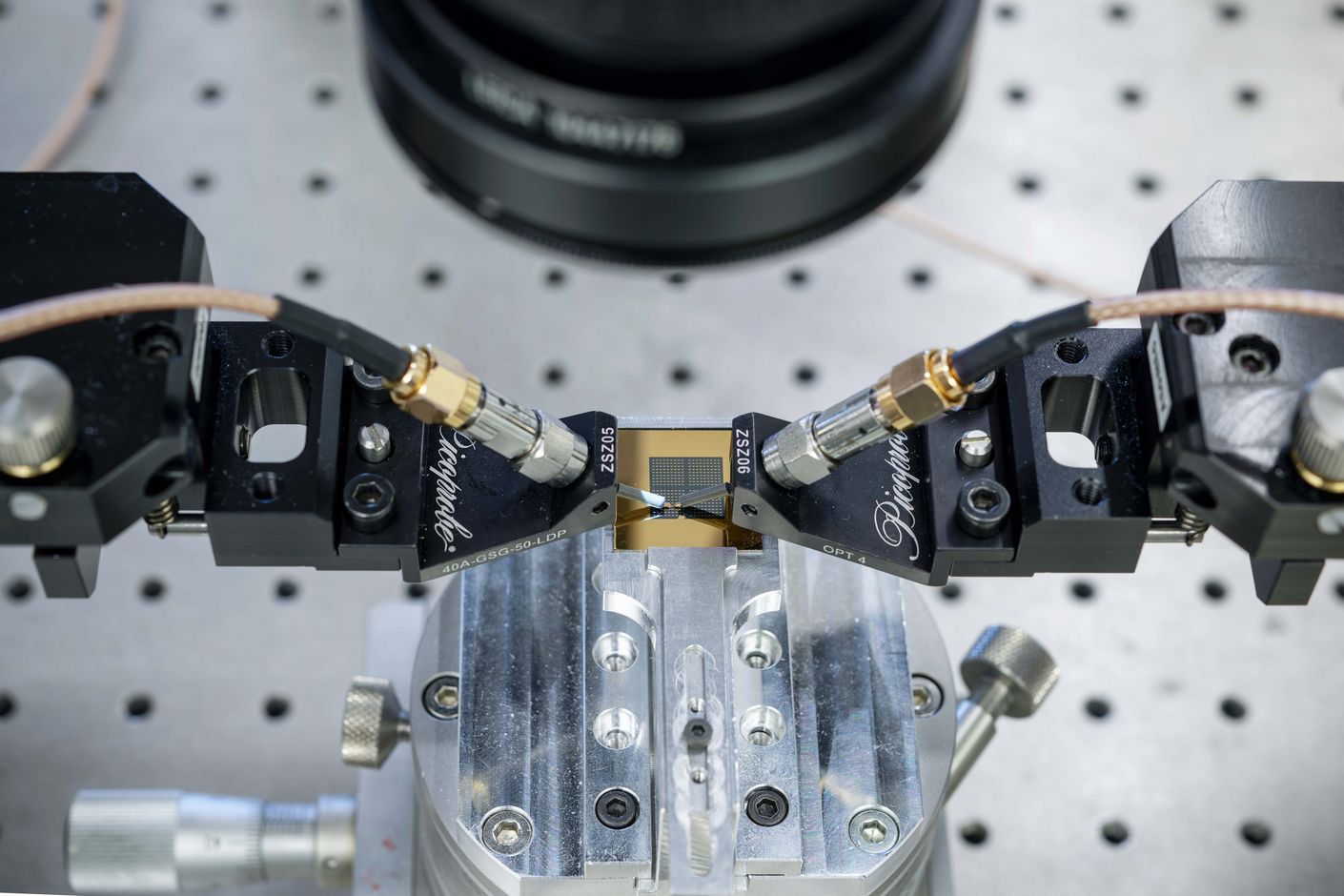
“This is why we urgently need transistors that use much less energy,” says Thomas Schimmel, professor of physics at the Karlsruhe Institute of Technology (KIT). In a project funded by the Werner Siemens Foundation, he and his team at the Center for Single-Atom Electronics and Photonics have spent the past eight years developing a highly promising concept: an atomic transistor in the form of a single-atom switch that involves using just a few atoms—even just one single atom—for the switching process.
Rather than the six to seven hundred millivolts of voltage needed in semi-conductor-based transistors, an atomic switch requires just a few millivolts to activate the switching process. In the project, Schimmel and his team even set a world record with a switching voltage of just three millivolts—which is two hundred times lower than conventional technology. “Because energy consumption increases with the square of the switching voltage, this represents huge energy-saving potential,” Thomas Schimmel says.
And that’s not the end of the story. Professor Jürg Leuthold at ETH Zurich, director of the Center for Single-Atom Electronics and Photonics, and the two co-directors, Professor Mathieu Luisier at ETH Zurich and Schimmel, believe more energy—indeed, much more energy—can be saved. In a follow-up project that WSS is financing with 4.2 million Swiss francs over the next four years, they intend to reach the physical limit below which information processing is no longer possible.
Taking it to the limit
Known as Landauer’s principle, this limit was postulated in 1961 by German-American physicist Rolf Landauer. It describes the minimal amount of energy needed to convert one bit of information into a defined state (0 or 1). “The switching energies of our atomic transistor are still well above Landauer’s limit,” Thomas Schimmel says. “We’ve come a long way, but we know we can do even better.”
The researchers’ optimism is based on recent results: in a series of unpublished experiments, they once again succeeded in drastically reducing the switching voltage in their atomic transistor. This new milestone was achieved by making changes in geometry and devising new methods for producing the nanoelectrodes.
Massive energy-saving potential
At present, these lower voltages don’t yet translate into the reliable, long-term operation of a component, as Schimmel and Leuthold concede. “Nevertheless, the results are a clear indication that the world record of three millivolts should in no way be seen as the physical limit of our component.” Indeed, they believe it will be possible to further reduce switching voltage by a factor of one hundred. This would dramatically lower not only the transistor’s energy consumption, but also that of the supply lines to the component. “Here, we’re talking about a reduction in supply-line losses by a factor of one hundred million or more,” the two scientists agree.
In addition to switching voltage, the researchers are also targeting another aspect in the follow-up project: the component’s capacitance, which influences the speed at which the transistor can be switched on and off. Currently, the switching speed of atomic switches aren’t yet fast enough to satisfy the requirements. Leuthold, however, believes that using innovative nanostructuring techniques to miniaturise the electrode surfaces and supply lines will bring about significant advances in this area, too.
And so the expedition to the lower limits of electrical engineering has commenced. Thomas Schimmel and Jürg Leuthold are ready for the
challenge: “Our goal is to provide a new technology for sustainable data processing—and we have everything we need to achieve it.”
![[Translate to English:]](/fileadmin/_processed_/5/3/csm_Report24-Nachhaltigkeit-Muster_2c7b6666b3.gif "[Translate to English:]")