


Implant ready for stress test
During its final year of funding, the “Smart implants” project once again made remarkable advances. The intelligent implant designed to stimulate healing in a bone fracture is now ready for the next level: fatigue testing and animal experiments. The technology developed in Saarland has also been integrated into a major EU-funded project.
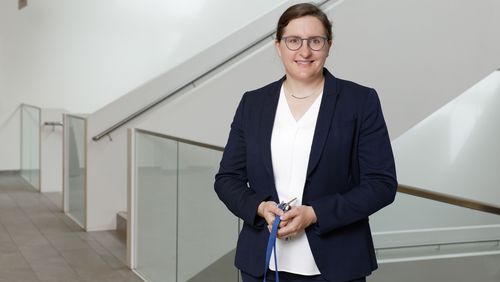
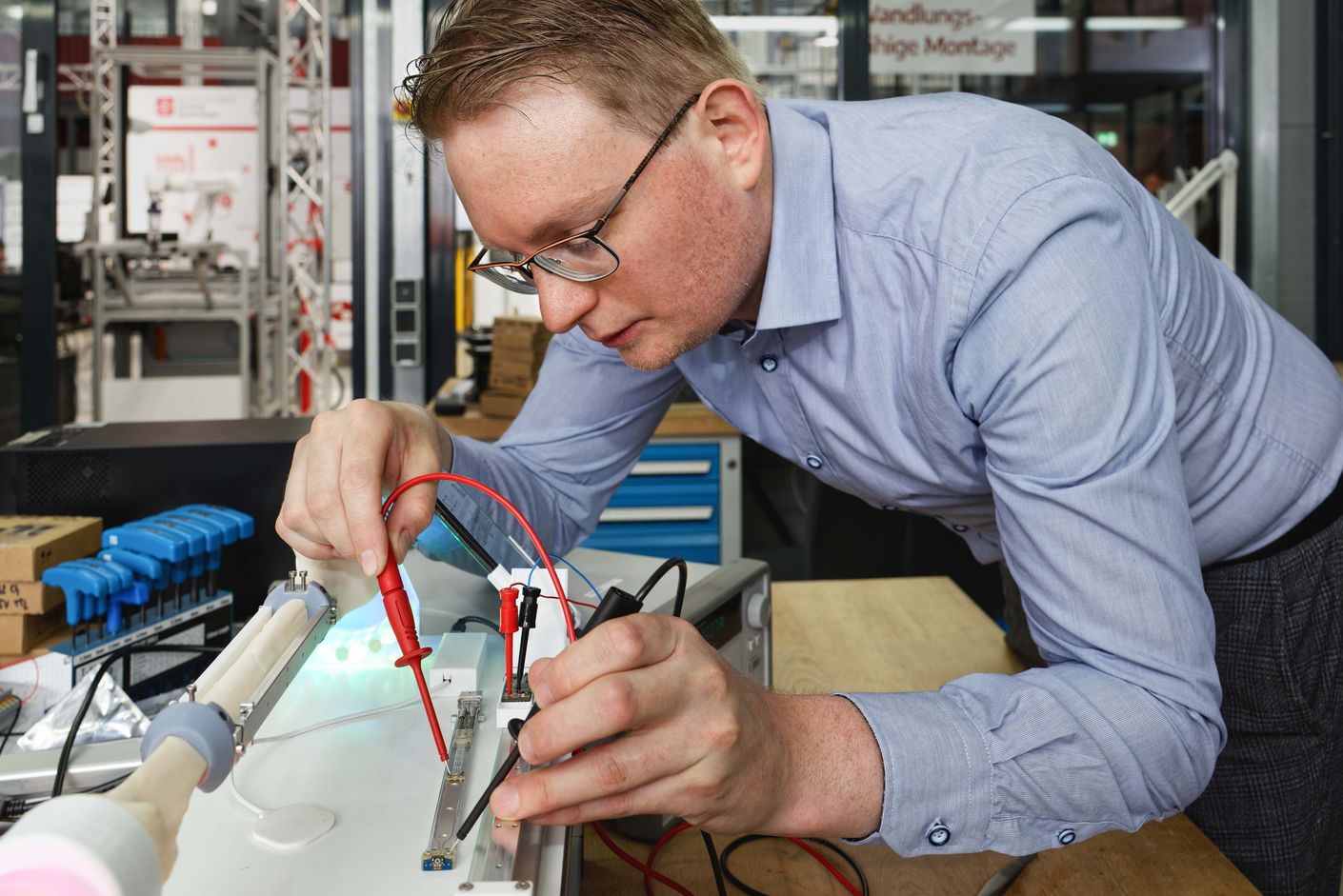
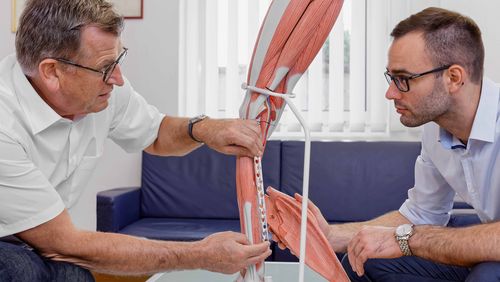
From idea to implant—this was the goal when the “Smart implants” project commenced seven years ago. Today, Bergita Ganse, WSS Endowed Chair for Innovative Implant Development at Saarland University can say with some satisfaction: “We’ve achieved our aim.” The researchers have succeeded in building an implant prototype that both stabilises a broken bone and actively stimulates healing through targeted micromovements.
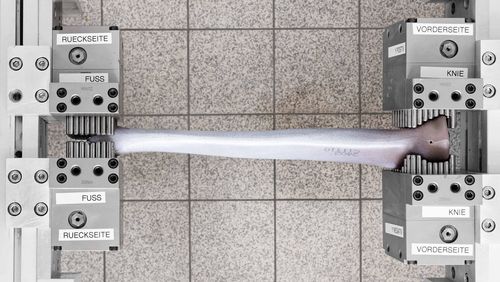
Recent months have seen such good progress made in further developing and improving the prototype that the researchers are now conducting fatigue tests and beginning the application process for animal experiments. For the tests, the implant and bone will be clamped in the testing device and subjected to thousands of loading cycles, Bergita Ganse says. “The tests will reveal any weaknesses the implant might have—for example, we want to know whether it can still measure precisely what we want to know, even after prolonged stress.”
Most of the fatigue tests are conducted using sheep bones, as the first animal experiments will involve sheep. However, it’s not yet clear when the animal tests can start, as animal experiments have a long lead time due to the complex application process, as Ganse explains. “But it’s fantastic that the project has come this far.”
Significant improvements expected
And how will patients benefit from the implant? When treating lower leg fractures, the current practice is to screw a metal plate onto the broken bone to stabilise it. Unfortunately, however, the bone doesn’t always knit well, with complications occurring in up to one in seven cases. The new smart implant delivers information on how well the fracture is healing and also detects incorrect weight-bearing. And more: if a break isn’t healing well, the implant will react.
For instance, if too much pressure or weight is placed on a fracture, the implant will stiffen, relieving strain on the injured bone. Conversely, if a patient is too sedentary, the implant will change its shape and become more flexible, thus increasing pressure on the bone. A new mechanism embedded in the implant can even massage the fracture site. Bergita Ganse anticipates that these micromovements will accelerate healing by around twenty percent. “That said, we’d like to try other ways to stimulate bone healing in
addition to massaging the fracture gap.”
In a literature review Ganse conducted, she concluded that methods using ultrasound, shock waves, electric currents or magnetic stimulation could also be used to shorten patient recovery times. She says we know magnetic fields stimulate cell division, adding: “Through a combination of micro-massages and magnetic field stimulation, I suspect we could speed up healing by around thirty-five percent.” Because the “Smart implants” project ended at the end of 2025, however, the Saarland researchers will be integrating these features and making other improvements to the implant outside the WSS funding programme.
Radiation-free monitoring
Over the past year, Ganse’s team also made a significant discovery regarding the techniques used to monitor fracture healing. Currently, the only way to determine how well a broken bone is healing is by using X-rays and CT scans—both of which expose patients to dangerous radiation and should therefore be used only very sparingly.
In two publications, the researchers discussed an alternative approach: they demonstrated that practical devices available on the market can be used to measure healing indicators such as blood flow and oxygen saturation at a fracture site. In future, doctors—or patients themselves—could place one of these devices on the skin at the fracture site every day. Or the technology could even be integrated into a smart implant, enabling it to provide continuous data on how well a broken bone is healing.
Elite EU project
In general, the potential of smart technologies in treating musculoskeletal diseases is great, something the EU Horizon Europe research programme has also recognised. Recently, the programme has allocated more than twenty million euros to the SmILE project, in which researchers investigate a wide range of technology-driven approaches to treating conditions such as osteoarthritis, osteoporosis—and bone fractures. Saarland University and the Center for Mechatronics and Automation Technology—two partners in the “Smart implants” project—are among the participating institutions.
“SmILE builds on our WSS project,” Bergita Ganse says. “The aim is to create a flexible chip platform for smart implants—not just for healing fractures but also for use in medical devices like hip and knee prostheses.” The project includes industry partners with a concrete interest in bringing these types of medical products to market. All in all, it seems the time is ripe for intelligent medical technology.


![[Translate to English:]](/fileadmin/_processed_/c/a/csm_05_Miracle2_f0b59aff08.jpg "[Translate to English:]")