


PV-Skin
Skin substitute for paediatric burn victims
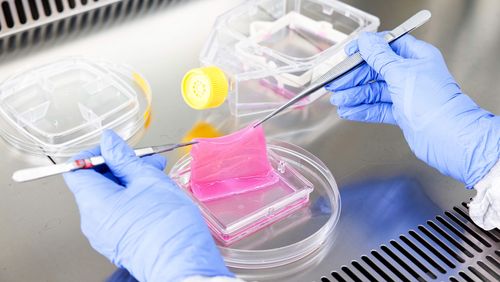
Severe burns and scalds are common in children—and modern treatments still fail to deliver satisfactory results. For the past twenty-five years, researchers at the University Children’s Hospital Zurich have been developing a skin substitute to improve medical care in such cases. Their innovation is now so similar to natural skin, that the first trials with human patients have been scheduled.
Articles about the project
The project in brief
Whether from touching a hot stove, playing with matches or knocking over a tea kettle: burns and scalds happen quickly, especially when children are involved. With their novel skin substitute—PV-Skin—researchers at the University Children’s Hospital Zurich are aiming to transform the treatment of paediatric burns.
Research into personalised skin substitutes made from a patient’s own cells began more than twenty-five years ago at the University Children’s Hospital Zurich. The first viable product contained two cell types found in human skin: keratinocytes, the barrier-forming cells in the epidermis, and fibroblasts, which are found in the connective tissue of the dermis. Despite its usefulness, however, it didn’t come close to matching the quality of natural skin.
Recently, a team led by Sophie Böttcher achieved a major milestone by further refining the skin substitute to include all four key cell types in human skin. In addition to keratinocytes and fibroblasts, their development also contains melanocytes (pigment cells) and endothelial cells, which play a vital role in the formation of blood vessels. Results from experiments in “test tubes” and on laboratory animals are encouraging: the new product, PV-Skin, is extremely similar to natural skin.
The pigment cells in the substitute ensure that a patient’s skin retains its natural colour. And decisively, the endothelial cells promote the rapid growth of capillaries, enabling the skin substitute to attach itself to the underlying wound bed within just four days. This boosts the supply of oxygen and the migration of cells, which leads to faster healing.
PV-Skin is now ready to be tested in clinical trials with human patients. Over the next three years, roughly ten patients with severe burns will each receive a seven-by-seven-centimetre PV-Skin transplant. If the outcomes are positive, children with burn injuries will have a much more hopeful outlook: the new skin substitute promises to accelerate the healing process, reduce the need for follow-up surgeries and be aesthetically more natural-looking—all of which positively impacts on quality of life.
Facts and figures
Project leader
PD Sophie Böttcher, MD, Zentrum Kinderhaut, Brandverletzte Kinder, Plastische und Rekonstruktive Chirurgie, University Children’s Hospital Zurich
Project
Researchers and clinicians at the University Children’s Hospital Zurich have developed the first-ever skin substitute that contains the four key components of natural skin. They’re now ready to test their "PV-Skin” in clinical trials with human patients. If successful, children with severe burns can look forward to a brighter future.
Funding from the Werner Siemens Foundation
1.5 million Swiss francs
Project duration
2025–2008