

Plastic-busting microbes
At the WSS Research Centre “catalaix”, catalysts play the leading role in the chemical degradation and conversion of plastics. But Mother Nature has also created molecules that can aid such processes. These are the kinds of microbial enzymes that Lars Blank and his team are using to break down and convert a variety of plastic molecules simultaneously.
When explaining the power of microbes, Lars Blank will point to the forest: when a tree falls in the woods, nature’s cleaning crew immediately springs into action. The main organisms involved in the decomposition of wood are tiny fungi and bacteria that release enzymes capable of cleaving even the most robust compounds in the wood. “Tree trunks contain a highly complex blend of polymers with celluloses, lignin, resins and aromatic compounds—but ultimately, the microbes will succeed in decomposing and converting everything,” Blank says.
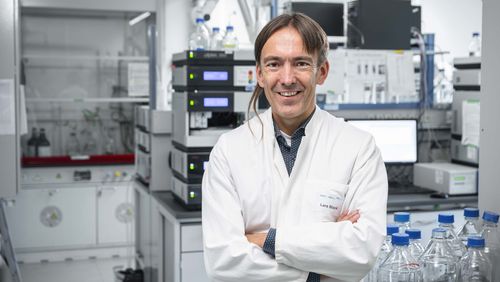
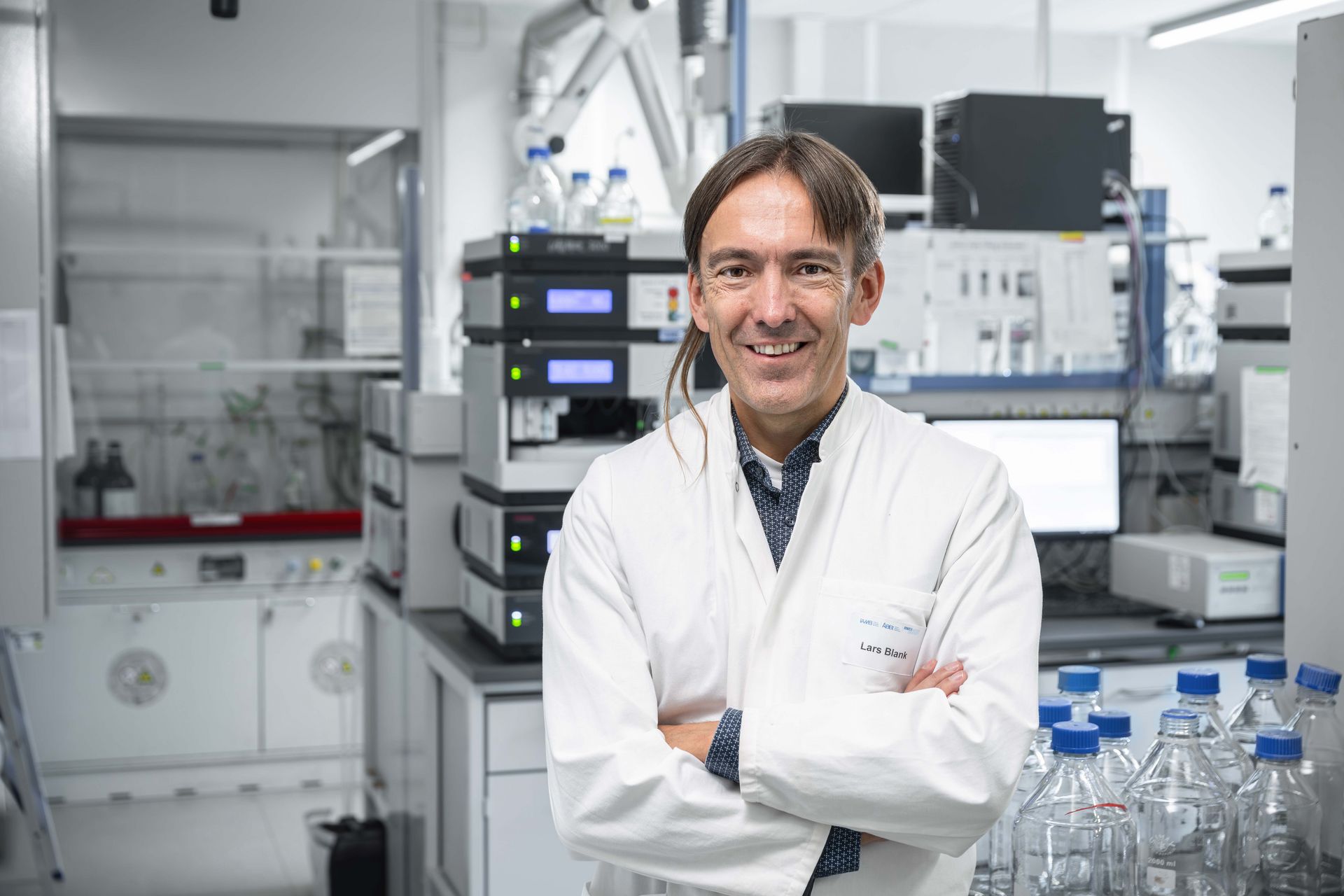
Lars Blank is Chair of Applied Microbiology at RWTH Aachen University and part of the five-member core team at the WSS Research Centre “catalaix”. His research focuses on microbial metabolism, and he investigates, enhances and develops microorganisms that can degrade a wide variety of substrates and then produce new molecules. In the catalaix project, the aim is enabling microbes to work their decomposing magic on materials made of plastic.
Just like naturally occurring cellulose, human-made plastics are also polymers—chains of molecules made up of smaller units known as monomers—albeit with a crucial difference. Unlike in the degradation of cellulose, microbes haven’t yet had millions of years to evolve and specialise in the degradation of synthetic polymers. In recent years, however, researchers have demonstrated that microbial enzymes are able to cleave and metabolise certain manufactured plastic polymers.
Enzyme from a compost heap
Lars Blank plays a short video on his computer screen to illustrate the process: inside a glass container, a transparent box performs bizarre contortions, then gradually shrinks until it disappears entirely. “That was an old raspberry package inside an enzyme reactor,” Blank explains. Inside the reactor, a piece of PET, one of the most common plastics, is broken down via enzymatic hydrolysis at a temperature of sixty-five degrees Celsius. Because the enzyme originally came from a compost heap, it’s adapted to such high temperatures.
That said, researchers didn’t simply find the enzyme in their neighbour’s compost. “It took twenty years of research to achieve this level of degradation activity,” Blank explains. They’re working with a particularly efficient enzyme that a research team in Leipzig first discovered only after many years of searching. Secondly, the Leipzig team had to isolate the enzyme, insert it into a suitable host bacterium and subsequently optimize it. A particularly useful method for this latter step is “directed evolution”: random mutations are produced in the enzyme’s gene. These modified enzymes are then tested for degradation activity. The best mutations are selected for the next round of “mutagenesis”, where new mutations are tested and selected—and so on.
In the catalaix project, however, Lars Blank sees the value of his microbes less in their ability to degrade a single polymer type such as PET. Rather—and similar to the scene in the forest—it’s their capacity to break down blends that makes them so interesting. “Our niche,” he says with a touch of modesty, “is in material blends that drive most chemists to distraction because the blends are too complex to be efficiently and economically broken down into high-purity molecules.” He adds that the process goes beyond degrading plastics. It also encompasses upcycling, or the production of new, value-added materials.
Four molecules at one go
Blank and his team recently published a study on an upcycling experiment that once again worked with PET as the starting material. The researchers developed a two-step procedure utilising enzymes and genetically modified bacteria to convert the plastic into value-added new products. In the first step, a polyester hydrolase enzyme cleaved the PET plastic into its two base components, ethylene glycol and terephthalic acid. In the second step, the researchers genetically modified bacteria from the Pseudomonas putida species, enabling them to absorb and metabolise both molecules concurrently.
The researchers “constructed” three versions of the bacterium, the first of which produced cyanophycin, a biopolymer that could prove interesting for use in medicine or agriculture. The second version converted the two starting molecules into HAA (a hydroxy fatty acid), and the third produced rhamnolipids. The second and third substances are surfactants, or “surface-active agents”, that have potential application in cleaning products and detergents.
And there’s more: in another experiment, Blank’s team demonstrated they can even feed four monomers to a single bacterium at the same time. In this study, the researchers worked with the four components of a PBAT/PET mixture: ethylene glycol, terephthalic acid, 1,4-butanediol and adipic acid. “After we introduced all four metabolic pathways into one bacterium, it exhibited excellent growth characteristics—and metabolised the four monomers more or less simultaneously,” Blank relates.
Next, the researchers engineered the microbes to produce a single new product from the four PBAT/PET monomers. “For this, we transplanted a synthetic metabolic pathway from another organism into the bacterium,” Blank says. The resulting molecule was—depending on the metabolic gene used—a hydroxy fatty acid with either ten or fourteen carbon atoms.
Additional biological approaches
Microbial enzymes and biological molecules are also the focus of other groups in the catalaix project. For example, researchers in the group led by Lars Lauterbach are working with microbial methods to produce high-value chemicals directly from CO2 and green hydrogen. Then, Jørgen Magnus and his team specialise in bioprocess engineering: they’re investigating how microbiological processes can be scaled up—in other words, how they can be made possible on a large scale, up to fermenters. Lastly, the research group led by Ulrich Schwaneberg is developing so-called binding peptides, which are proteins that adhere to surfaces. These molecules represent an extremely interesting approach to attain novel cleaving techniques: various material-specific binding peptides could one day be used to label and efficiently separate the different types of plastic in mixed plastic waste (see article: What’s left from the leftovers).
Where chemistry and microbiology meet
“This means we can use enzymatic conversion processes to break down durable plastics like polyester into different monomer types that we then feed to microbes, enabling them to produce high-value materials,” says Blank. This achievement illustrates how microbiology augments chemistry in the catalaix project. “Using the tools of chemistry alone, it’s very challenging to convert completely different molecules like aromatic compounds, diols or carboxylic acids into a single new molecule. But that’s precisely what we’re doing.”
Interdisciplinary teamwork is writ large in the catalaix project. As an example, chemistry might underlie the initial degradation steps, after which microbiological methods are employed to feed the molecules to microorganisms and produce new materials. Then, once process engineers have separated these new products, they’re returned to the chemistry lab, where they serve as the starting materials for new plastics.
The exact nature of this collaboration and the individual steps involved depend on the plastic material used. “Different plastics require different processing cascades,” Lars Blank says. “But our chief aim is integrating various scientific disciplines in order to retain the carbon atoms from plastics in the production cycle.”
Keeping it real
The path to achieving circularity is anything but straightforward. “Currently, we buy the monomers for our experiments from a chemistry catalogue,” Blank says, “or we use products developed by our chemistry colleagues who, however, have also used pure starting materials.” This is problematic because real-world waste streams are rarely pure. Indeed, plastic debris is often discarded haphazardly: leftover food is stuck to packaging, for example, and plastic toys have a coloured coating. “It’s essential that our lab experiments increasingly resemble these authentic conditions,” Blank explains.
To this end, his research group is studying how microbes could process the additives found in most plastics. These substances imbue plastics with a variety of interesting properties: reinforcing agents increase stability, lubricants improve workability, flame retardants reduce flammability, and stabilisers protect against heat or light.
When analysing real-world, hence impure, plastics in the lab, a complicating factor is that often only the manufacturers themselves know which—and how many—additives are in their products. Blank has hopes that one of his industry partners will soon supply the researchers with a list of additives used. This example illustrates how creating a more sustainable plastics industry will require action on many fronts. The flexible and interdisciplinary teams in the catalaix project are more than well equipped to take on the challenge.