

What’s left from the leftovers
Collecting and sorting mixed waste is no simple task. Even specially designated waste receptacles—such as Germany’s “yellow bags”—often contain a considerable amount of non-recyclable material.In the catalaix project, researchers led by Kathrin Greiff are seeking ways to deal with this residual fraction.
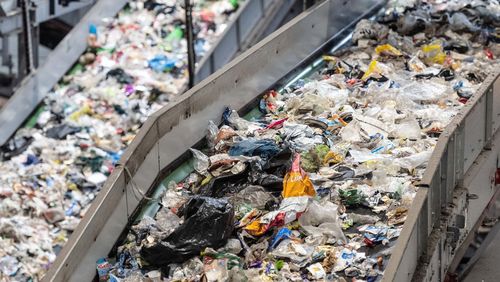
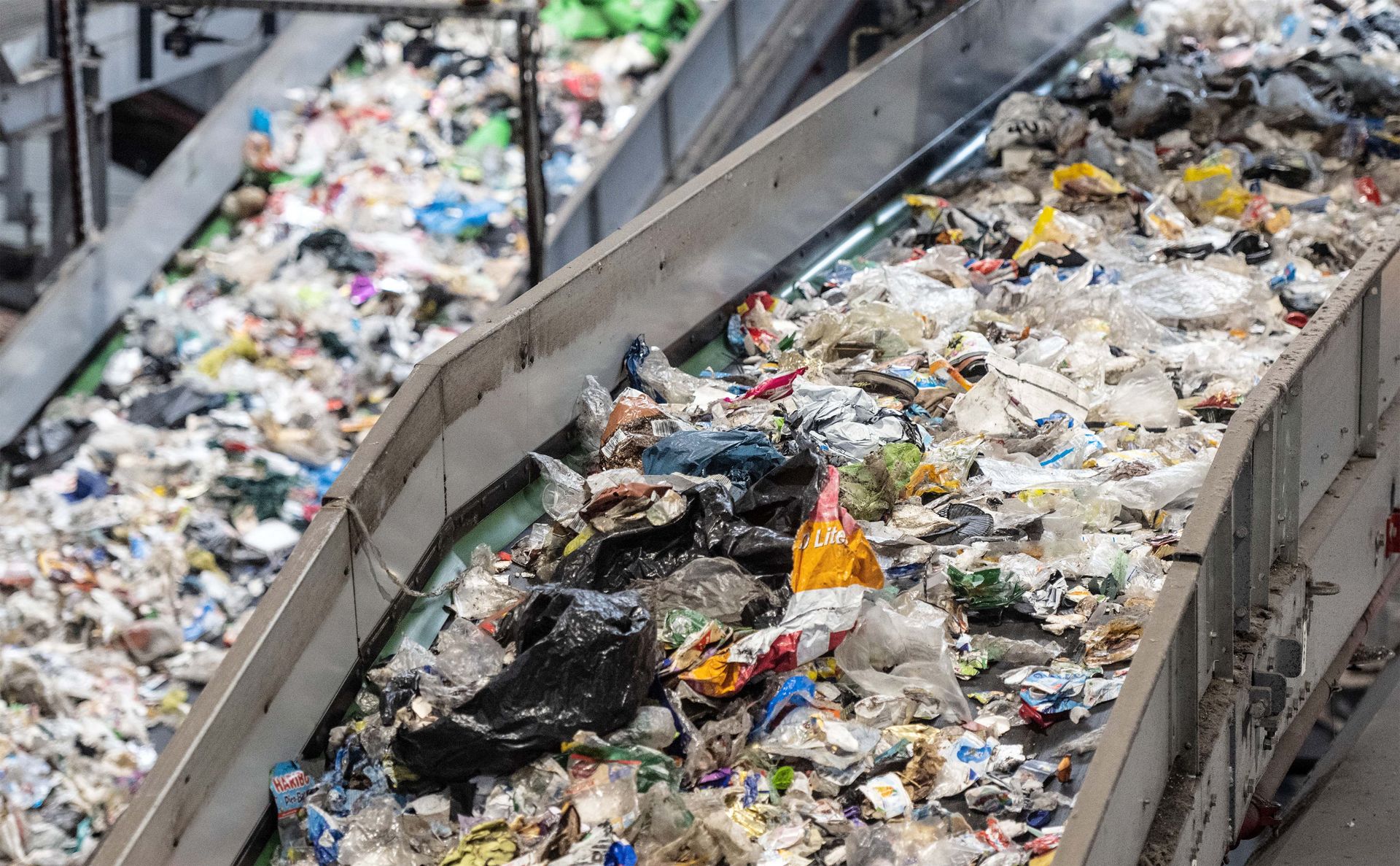
Everyone in Germany is well acquainted with the “yellow bags” and “yellow bins” used to collect lightweight packaging waste made of plastic, aluminium, metal or composite materials. When full, the bags and bins are brought to a materials recovery facility, where the contents are sorted and prepared for mechanical recycling.
To separate the various materials collected in the bags, a wide range of automated sorting technologies are used. First, fine-grained material is screened out, then plastic films are removed using a type of winnowing technology in which air classification carries off lightweight materials. Next, electromagnets pull ferrous metals from the conveyor belt, after which non-ferrous metals like aluminium are magnetised and ejected by a rotating magnetic field called an eddy current separator.
Last but not least come near-infrared sensors that recognise different types of plastics and beverage cartons based on the spectrum of light they absorb. When a sensor identifies a polymer, a jet of air is activated to shoot the object into the right fraction. Because each type of plastic reflects infrared light differently, this method can be used to separate and recycle common polymers such as polyethylene (PE), polyethylene terephthalate (PET) and polypropylene (PP).
Residual waste streams
“These sorting systems work very well within current technical limits,” says Kathrin Greiff, Chair of Anthropogenic Material Cycles at RWTH Aachen University and one of the principal project leaders at the WSS Research Centre “catalaix”. “But a considerable stream of residuals is still leftover, most of which ends up in the incinerator.” Depending on what has been thrown out, up to fifty percent of the content in a yellow bag isn’t recycled.
Most of this leftover waste consists of items that shouldn’t have been discarded in the yellow bags and bins in the first place—food, nappies and textiles, but also objects such as flashing shoes with built-in batteries that belong in the electronic waste collection. The rest arises due to deficiencies in current separation and sorting technologies—for example, recyclable items can be hidden beneath other objects on the conveyor belt, and light sensors are sometimes unable to identify plastics coloured with carbon black.
Kathrin Greiff and her team conducted detailed studies into the exact make-up of this residual fraction. After removing three dozen ninety-litre samples of the “leftover leftovers” from a materials recovery facility, they repeated the separation step with the infrared sensor. Then, they worked by hand to sift through the residual fraction and identify the various types of plastics.
Steak and yoghurt
This complex and potentially disagreeable task was led by Alena Maria Spies, head of the Processing and Process Chains research group at the Chair of Anthropogenic Material Cycles. Last autumn, she presented the findings at a symposium in Sardinia, Italy. “We found a very large proportion of biomass in the residual fraction, often in combination with plastic packaging,” Spies explains. Examples include half-eaten yoghurts and steaks still in their packaging.
To estimate how much of the residual fraction might still be suitable for recycling, the researchers calculated the quantity of effective dry matter of the leftover food in their samples. “In fractions with a lot of biomass, the water content in some cases amounted to more than thirty percent,” Spies says. “So, water makes up much of the weight of materials found in residual waste—and, of course, water isn’t a recyclable material.”
Nevertheless, a wide range of different plastic types were also in the mix. In addition to standard plastic packaging made of PE, PET and PP, the researchers identified relevant amounts of other polymers, including PVC, PA and ABS. This indicates that there’s still potential for improving current sorting technologies, hence increasing the amount of materials separated for recycling. The next step will be to identify the best methods to achieve this aim—methods that are ecological, economical and technically optimised.
From data to model
These types of calculations and predictions are the speciality of Kathrin Greiff’s research group, which develops models to evaluate and monitor material streams—and also simulate optimisation measures. The researchers get creative when proposing pathways for improving processes, asking questions such as: What happens when packaging designs change? How much will the sorting success rate improve when less food waste is in the mix? And crucially: For which material streams would it be feasible and worthwhile to develop catalysis-driven recycling methods?
Greiff says the type of collaborative approach encapsulated in the third question is now taking place in the catalaix project. “Our job is to identify potential material streams—and our colleagues from the catalysis department then seek ways to chemically break down the materials and introduce them back into the cycle.” This, she says, is the biggest advantage of the WSS Research Centre: “Previously, each research area tended to work alone. Now, we have the opportunity to bring together the various different perspectives in order to close gaps and generate the knowledge we need to achieve our goal of a circular economy.”