



Concentrated sunlight for affordable power
The tandem solar cells developed by researchers at the Fraunhofer ISE in Freiburg im Breisgau can be connected using yet another promising technique: high-concentration photovoltaics, which couples high conversion efficiency with extreme economy in the use of semiconductor materials.
High-concentration photovoltaics is one of the most exciting developments in photovoltaic systems. In this process, inexpensive lenses are used to amplify sunlight by a factor of one thousand, focusing rays onto a tiny solar cell just a few square millimetres in size, where light is converted into electricity. Frank Dimroth and his research group at the Fraunhofer Institute for Solar Energy Systems ISE in Freiburg im Breisgau are global leaders in this technology. As a case in point: a few years ago, the team produced a solar cell with an efficiency of 47.6 percent when exposed to sunlight concentrated 665 times—a world record.
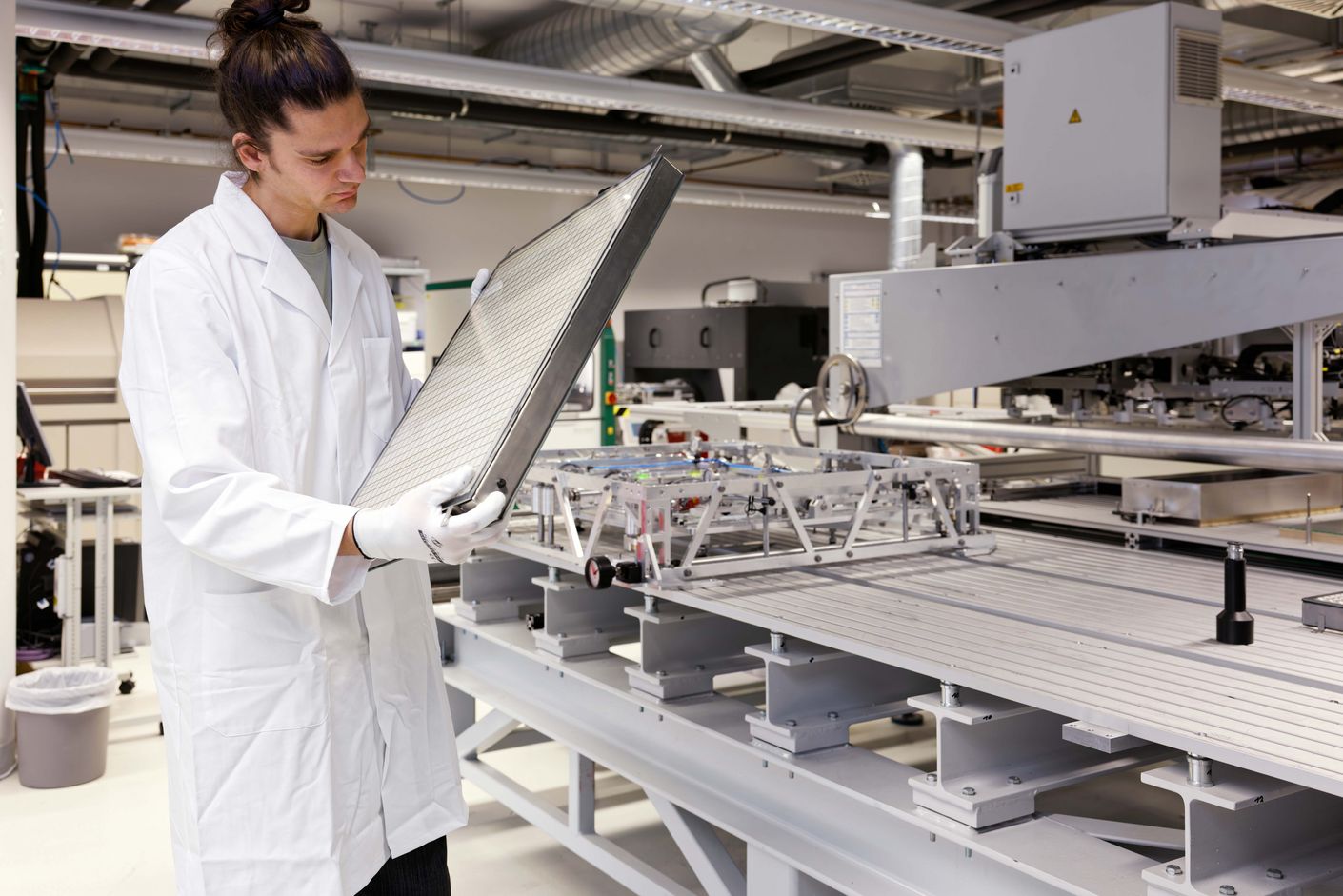
The combination of III-V semiconductor multi-junction solar cells with high-concentration photovoltaics represents a key element in the new WSS project. “With this approach, we can reduce the amount of semiconducting material by another factor of one thousand, which will enable us to achieve competitive electricity generation costs more quickly,” Frank Dimroth says. Indeed, the technology is already so advanced that the researchers are planning a spin-off company—Clearsun Energy—for producing and marketing high-concentration solar modules. Using the prize money from the final round of WSS’s one-hundred-year anniversary competition, the Freiburg researchers completed the first step in scaling up the module to roughly the size of a computer screen. The team at the new spin-off company have now set their sights on modules measuring two by four metres.
A sophisticated idea
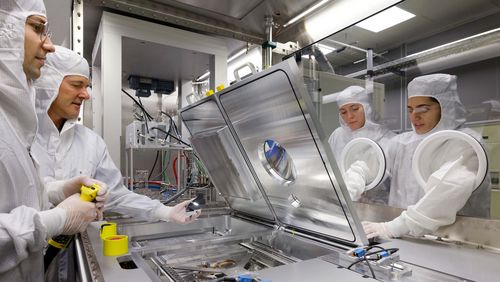
Work on studying and refining the manufacturing process is conducted at two labs on the ISE campus. In one of the labs, minuscule solar cells are applied to a glass baseplate with a conductor track pattern. In the next step, a small drop of silicone is placed on each cell, and a glass sphere—a ball lens—with a diameter of just 1.6 millimetres is placed on the silicone droplet. To achieve high throughput in production, it will be important in future that the components are placed all at once rather than one after another. The researchers are already seeking solutions to this problem.
Frank Dimroth demonstrates the ingenious idea in one of the lab spaces. The researchers built a template the size of a solar module, with recesses precisely where the ball lenses should fall in place. When the ball lenses are distributed over the template, they roll into these recesses. A vacuum attachment then picks them all up at once and places them on the solar cells in the module. Dimroth says the system has yet to be perfected. “For example, we still need to make sure the lenses are truly one hundred percent radially symmetrical and that they don’t get stuck in the recesses.”
Once the ball lenses are in place, the panel containing them and the solar cells is inserted into a frame with a front glass panel, which is imprinted with additional silicone lenses. In a two-step process, the sunlight is concentrated by these lenses and the glass spheres—whereupon its intensity increases by a factor of one thousand before it’s converted into electricity in the solar cells.
Minimising costs
High-concentrator modules function particularly well in regions with intense solar radiation—for example, in southern Europe, parts of the US, or Africa. By contrast, the lenses can’t focus the diffuse light often found in northern latitudes, making it less suitable for electricity generation. But even in sunny regions, modules must be in precise alignment to the position of the sun at all times to attain an optimal concentration of the sun’s rays; Dimroth says such solar tracking systems are standard today.
Frank Dimroth envisions using his novel solar cells in sun-rich countries—indeed, his aim is to make high-concentration photovoltaics the most economical source of energy in such regions. The technology has the further advantage of being particularly ecological due to its
energy-efficient manufacturing processes and extremely high conversion efficiency. The ultra-thin tandem solar cells developed in the new WSS project could be the decisive factor in boosting economic viability of the process, especially given that existing concentrator modules use III-V semiconductor multi-junction solar cells with their germanium substrate.
“The germanium substrate is why the cells—even with their small surface area—still account for nearly half the total cost of a module,” Dimroth explains. “The ultra-thin, substrate-free cells we’re developing have the potential to lower production costs significantly.” If the researchers succeed in integrating the super-thin semiconductors into the concentrator modules, calculations made at Fraunhofer ISE suggest that solar power could be produced in countries with abundant sunshine for less than two euro cents per kilowatt hour.
