

AI-based predictions in the chemistry lab
Artificial intelligence is opening the door to incredible possibilities in the world of science. The field of chemistry is no exception, as seen at the “catalaix” WSS Research Centre, where machine learning will be used to develop new plastic molecules as well as cheap and sustainable methods for recycling mixed plastics—while also speeding up the translation of lab findings into industrial practice.
Working in a chemistry lab can be much like seeking the proverbial needle in a haystack: developing and testing new molecules, reaction pathways and process engineering systems is incredibly complex and time-intensive. For several years now, artificial intelligence has been widely viewed as a promising solution for refining and accelerating such processes. The tools include machine learning models that are trained on specific data, learning from them what they need to predict molecular properties, thus enabling them to help design new molecules.
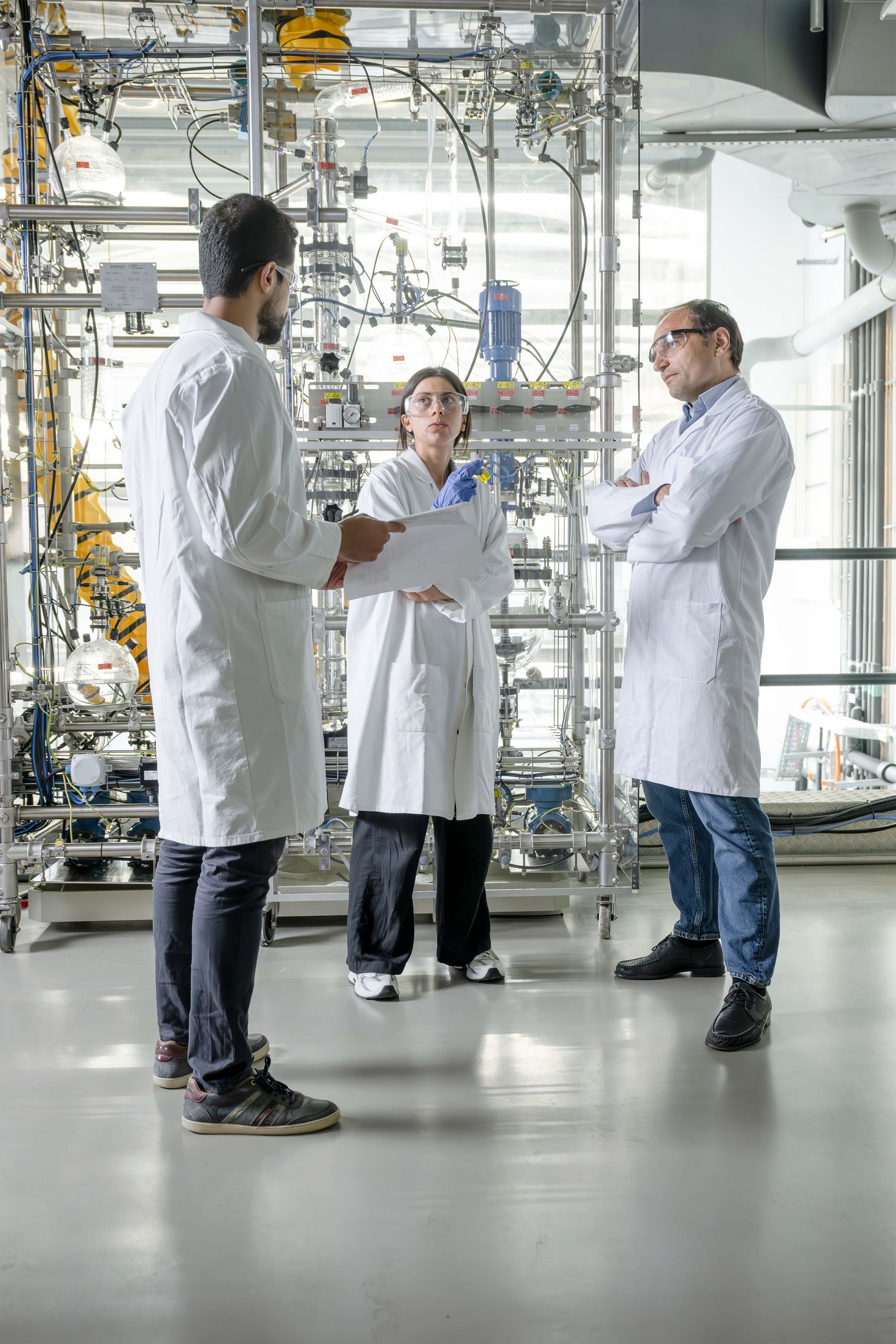
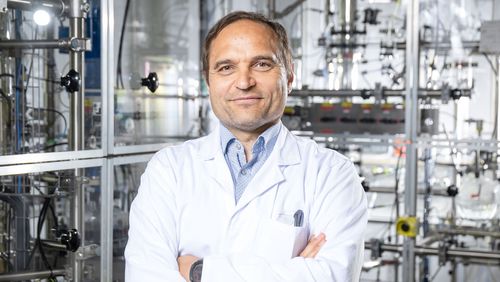
At the “catalaix” WSS Research Centre in Aachen, researchers from the fields of chemistry, process engineering and computer science are working together closely to capitalise on the great potential held by AI. “Our idea is to design hybrid models,” says Alexander Mitsos, professor of process systems engineering at RWTH Aachen University and member of the catalaix core team. “We’re combining machine learning with our knowledge of physics and chemistry to make the best-possible decisions.”
As part of this work, the researchers restrict the machine learning models to exclude results that go against the laws of physics. For example, the models are programmed to automatically comply with molecular symmetries, adhere to the structural characteristics of polymers, and obey the laws of thermodynamics. “With this approach, we need fewer data for the model to achieve the desired accuracy—or we get better predictions with the same amount of data,” Mitsos explains.
Translating chemistry into numers
To build the machine learning models, the first task for the researchers is translating the structures of chemical molecules into a readable format for computers. Graph representations are a particularly promising approach, says Karim Ben Hicham, PhD student in the research group of Alexander Mitsos. Graphs are abstract networks in which molecules are depicted using nodes and edges. Each node represents an atom, each edge represents a bond.
“Neural networks store information in numerical form for each node and each edge,” Ben Hicham explains. For example, one number might represent an oxygen atom, another a double bond, and so on. In a predictive model, the neural network learns, step by step, how the information has to flow through the molecular network in order to make the most accurate possible prediction of the material properties.
“Interdisciplinary collaboration is extremely important for developing and applying these kinds of advanced AI methods,” Mitsos says. “At the catalaix Research Centre, combining algorithmic expertise with application knowledge is common—for example between the group of Professor Martin Grohe, Chair of Logic and Theory of Discrete Systems, and my own group."
Complex molecules, complex processes
Predictive AI models still have certain limitations. “They deliver the best results when they’re used with relatively small molecules that have well-defined molecular formulae,” Mitsos explains. “But our goal is to apply them to complex molecules like polymers and for process design.” Regarding the latter, it’s crucial that the AI prediction tool ensures not only that a molecule has the desired properties but also that it can be produced safely, cheaply, quickly and efficiently at scale.
In one catalaix project, researchers are seeking to use machine learning to better predict the so-called liquid-liquid equilibrium between plastic polymers and solvents. In the field of process engineering, these equilibrium states are important for separating polymers out of solutions. “It’s considerably more challenging to construct thermodynamically consistent models for complex polymer mixtures than for smaller, well-defined molecules,” Ben Hicham says.
Efficiently separating mixed plastic waste
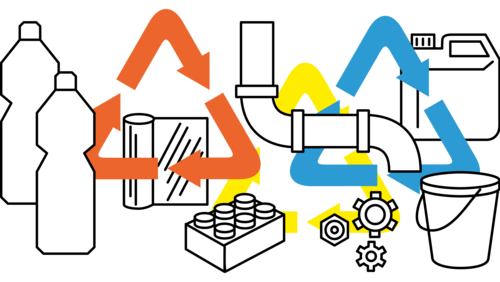
Another current project focuses on the purification of polymer blends. “Multi-layered plastic products—bags for crisps, for example—are a typical example of what we’re studying,” Ben Hicham explains. As a rule, these blends must first be separated before they can be chemically recycled. “We’re using machine learning models to identify which solvents we need and the order in which we should use them with the aim of finding a cost-effective method to separate the polymer blends into individual polymer types.”
Ben Hicham says the project is incredibly complex, adding that finding selective solvents is a particularly challenging aspect. The main problem is that some of the polymers in the blends are very similar, but a solvent must still extract one, and only one, polymer type—and leave the rest of the material intact. In the next step, another solvent is responsible for extracting another polymer type. And so on.
Alternative to Bisphenol A
Yet another AI-based project at catalaix concerns molecular design. “We’re especially interested in developing an alternative to Bisphenol A,” Ben Hicham relates. Bisphenol A, or BPA, is a compound found in plastic bottles, toys, parking tickets, on the inside of tins and in many other everyday products. Because BPA disrupts the human endocrine system, European countries have begun regulating its use. Finding a sustainable replacement is currently a major challenge in chemical research.
The requirements for an alternative molecule are exacting: it must have the mechanical stability, transparency and processability of BPA, but none of its detrimental effects. It should also be cheap to produce and recycle. Ben Hicham says, “We’re working with experimental chemists to develop predictive models to find molecules that fulfil the criteria.”
Limited data sets
When using machine learning models in chemistry, a prevalent problem is the availability of data. “AI tools like ChatGPT are built on huge data sets,” says Alexander Mitsos. “But we have to try to get good predictions with relatively small data sets.” Because experiments are costly and technically complex, data for many chemical substances are lacking, and the existing data are incomplete or have poor comparability.
Moreover, many data are the property of firms that don’t want to squander their competitive edge by feeding their knowledge into publicly available AI models. “We, too, are interested in maintaining and strengthening the European chemical industry,” Mitsos says, stressing that this is why a mutually beneficial collaboration would be ideal. He believes the best approach is for science to develop methods using open data, and then transfer this knowledge to industrial partners.
The big advantage of the catalaix research centre in this regard is its broad organisation. “We have a large team, and everyone knows the only way we’ll achieve our ambitious aims is by working together,” Mitsos says. To promote this collaboration, various chemistry-based groups at the WSS Research Centre provide data on molecules and reactions, while other teams contribute their expertise in scaling, process engineering, market forecasting, data modelling and AI. All with the aim of quickly transforming the chemical industry into a sustainable circular econom