



High-efficiency solar cells
Ultra-efficient tandem photovoltaics
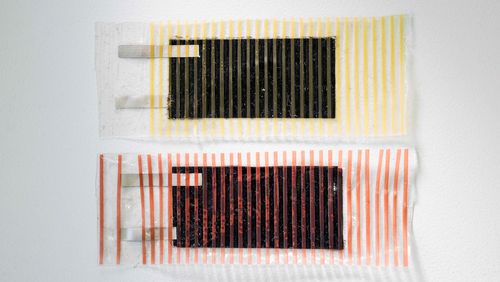
Although tandem solar cells have a much greater conversion efficiency than conventional silicon cells, they’re still much too expensive for widespread use. Now, researchers at the Fraunhofer Institute for Solar Energy Systems in Freiburg im Breisgau are developing a low-cost, high-efficiency solution—with ultra-thin solar cells and very little material.
Articles about the project


![[Translate to English:] Wenn Passatwinde im Golf von Panama das warme Küstenwasser aufs Meer hinausschieben, strömt aus 300 bis 400 Metern Tiefe kühles, nährstoffreiches Wasser nach.](/fileadmin/_processed_/b/a/csm_01-WSS-News-Seibold-upwelling_a08a676efb.png)











![[Translate to English:]](/fileadmin/_processed_/8/b/csm_01-WSS-Report23_c3f9fc08c9.jpg "[Translate to English:]")




![[Translate to English:]](/fileadmin/_processed_/6/d/csm_02-WSS-News-Flora-Chiper_01_7d2e2c4805.jpg "[Translate to English:]")




![[Translate to English:]](/fileadmin/_processed_/d/f/csm_01_WSS_News_Beton_90d32370a8.jpg "[Translate to English:]")







![[Translate to English:]](/fileadmin/_processed_/7/b/csm_WSS_08_News_Rahel_Schmidt_2479bedc21.jpg "[Translate to English:]")



![[Translate to English:]](/fileadmin/_processed_/c/a/csm_05_Miracle2_f0b59aff08.jpg "[Translate to English:]")
The project in brief
Photovoltaics systems are probably our best shot at combating global warming. But meeting the world’s energy demand using today’s silicon technology would require covering vast areas of land in solar panels. This is set to change thanks to the novel, highly efficient solar cells being developed by a research team at the Fraunhofer Institute for Solar Energy Systems ISE) in Freiburg im Breisgau.
Tandem solar cells, also known as III-V multi-junction solar cells, are at the heart of the innovative project at ISE. The cells consist of two to six layers of semiconductor materials made up of elements from the third and fifth groups of the periodic table—gallium, indium, arsenic or phosphorus, for example. The fact that each layer absorbs a different spectrum of sunlight gives the cells’ conversion efficiency a considerable boost. Indeed, compared to current state-of-the-art silicon-based cells, they generate roughly a third more output.
The downside is that the material and production costs for tandem solar cells are currently one hundred times higher than for standard solar cells. One reason for the high costs are the materials involved, which are considerably less common and more expensive than silicon. In addition, today’s manufacturing processes aren’t geared towards cost-effective mass production.
To improve the price-to-performance ratio of III-V multi-junction solar cells, the Freiburg team are pursuing various lines of research to develop ultra-thin, ultra-efficient solar cells that use as little material as possible. Their approach incorporates concentrator photovoltaics: inexpensive lenses are used to amplify sunlight by a factor of one thousand, and a tiny solar cell then converts the light into electricity. They’re also developing strategies to reduce manufacturing costs across all production phases.
Facts and figures
Project leaders
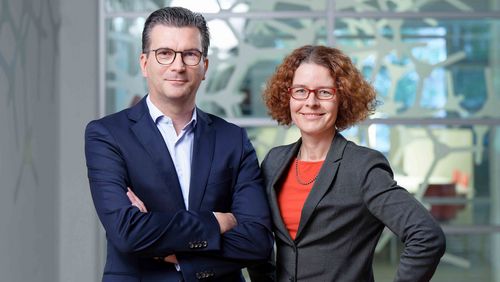
Dr Frank Dimroth, Head of the Department for III-V Photovoltaics and Concentrator Technology,Fraunhofer Institute for Solar Energy Systems ISE Freiburg i. Br.
Prof. Dr Andreas Bett, Institute of Physics, Albert Ludwig University of Freiburg i. Br., Director of the Fraunhofer Institute for Solar Energy Systems ISE Freiburg i. Br.
Project
Researchers at the Fraunhofer Institute for Solar Energy Systems ISE in Freiburg im Breisgau are aiming to develop next-generation photovoltaic systems—with tandem solar cells made of multiple layers of semiconductor materials. Although this particular technique dates back to the 1980s, the large-scale production of these solar cells is still much too expensive for commercial use. The Freiburg solution is designed to boost efficiency and streamline manufacturing.
Funding from the Werner Siemens Foundation
14 million euros
Project duration
2025 to 2032